Twice Transplanted. Still Dancing. Still Following Her Passion.
I’m Aware That I’m Rare: the phaware® podcast
Episode 595 - Jennifer Lombardi
Most people never face one life-saving transplant. Jennifer Lombardi has survived two. She’s lived through heart failure, bloodstream infections, chronic rejection, and unimaginable grief. Today, when the music hits and she steps onto a dance floor, adrenaline floods her veins and she remembers why she fought so hard.
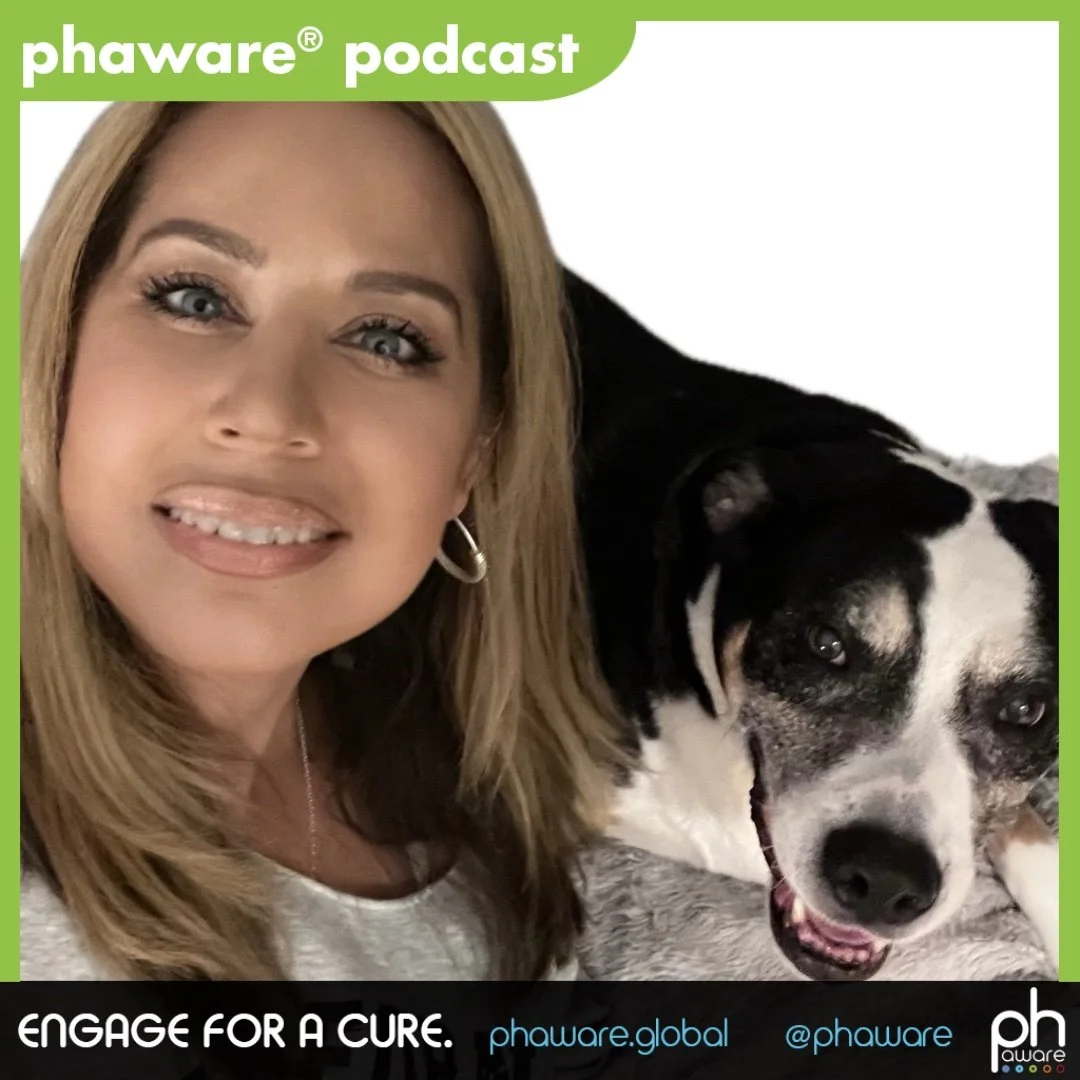
I’m Jennifer Lombardi. I’m from Long Island. I was 21 when I was diagnosed, and I was misdiagnosed for almost a year. Being misdiagnosed almost killed me, because they just kept saying, “We don’t know. We can’t see anything wrong with you. Nothing in your X-ray is showing anything.” I kept explaining to them that it was hard to breathe. But when you’re 21, it’s hard to explain the symptoms that you’re having. They kept telling me it was allergies. “It’s probably allergies. Go see an allergist.”
I was at school at Villanova. I’d been a dancer my whole life. I was on the Villanova dance team, dancing every single day, captain, choreographer, all of that. I never smoked, I never did drugs, I never took diet pills, which apparently were the three main causes of this illness at that time, at least. So they were very quick to kind of brush me off and say it’s something else. “This isn’t serious. Go see an allergist.” Until I started collapsing off the basketball court after dance.
It took someone on the outside to say, “Your lips are blue. This is not allergies. This is what you need to tell the pulmonologist.” What did I know? I was only 21. I had to go to the ER and they did one of those scans with the dye. Even then, they sent me back to my dorm saying, “We didn’t see anything wrong. Go see an allergist.” They actually brought down their psychiatrist to speak to me, because they started to think I was a hypochondriac and there was nothing wrong. My parents had driven up from Long Island for this ER visit only to drive back that night.
The following morning, they got a phone call and I had a million messages on my cell phone, which was turned off, because I had so many meetings that morning. They had a resident initially read my report, and he didn’t see anything. So he sent me home on his discharge. Then, they had a specialist read it. The specialist is the one that saw the dilated pulmonary artery and basically said, “She needs to come back, and she needs to come back now.” That whole day, they were trying to get ahold of me. Finally, at the end of the day, when I turned my cell phone on, I had all these messages. I had to drive myself to the ER, park, go in and say my name. They were like, “Well, we’ve been waiting for you.”
They were telling me all of these scenarios, they weren’t sure if it was a hole in the heart. I didn’t know that there were certain words that I should have used, like shortness of breath, because once you say shortness of breath, it’s like a game changer. That’s when they bring out the correct tests to measure your symptoms. That’s basically what happened. They’ve transferred me into the city the following morning at Penn Presbyterian. Dr. Harold Palevsky was a world-renowned doctor. He was working in that hospital. He had a whole pulmonary hypertension wing. So, that’s when they finally, after 10 months of being misdiagnosed, they finally did a right heart catheterization. That’s how he was able to figure out that I had pulmonary hypertension. It was idiopathic, because nobody in my family had it. I did stop breathing when I was born four times as a baby. I had to stay in the hospital and have all these tests done. But in 2006, there was no connection to that. They said it was unrelated. They kind of maintained that this entire time. They still don’t know where it came from.
That’s when it started. It was in ’06. I was 21. I turned 22 two months later and they said, “Had we not diagnosed you when we did, you wouldn’t have made it to 23. You might’ve made it to 22, but definitely not 23.” My priority at that time was going on interviews for a job, because I was graduating. I was a senior. I went from going to interviews to doctor appointments, where they’re telling you to get your affairs in order. It’s like, well, what type of affair do I have at 21, 22? That was crazy. You become numb to some of it, because you’re just like that kid. “Is this real life?” The one thing they kept saying is, “This is going to be tough.” I was like stage three, four. I just was shy of having the transplant then in ‘06.
I had to be put on Flolan, which is that intravenous pump, a catheter in the heart connects to an IV, which connects to a pump that I had to program every single morning and mix my own medication every single morning for the following morning, so that you had a cassette in reserve. I’m doing this in my apartment my senior year at Villanova. I had this whole setup. I was okay with it because I felt so sick for so long. I had right heart failure. My classes, it just so happened, they were on the opposite side of the campus and I’d have to walk. I had to give myself, what used to take five minutes to go from my house to class, now I had to give myself two hours. That’s how long it took. And it was on the fourth floor. So imagine having heart failure and having to go through all of that stress, and dancing too.
Dr. Palevsky said I’d have to go on the pump. I was okay until my mom was like, “Be prepared. You may not be able to dance again.” Then I wasn’t okay. So when he came in to tell me what I was about to go through, I kind of interrupted him and said, “Am I going to be able to dance?” It felt like an eternity. He was like, “So, as long as you can handle it, you can still dance.” Then I was fine. I didn’t care. I was like, “Bring on the IV, bring on the pump. I got it.” I still dance. I would duct tape the pump into the back, in between my shoulder blades. I’d have one of my teammates help me duct tape or electrical tape the pump to my back before halftime, so that I could still dance. And I did. I did that my whole senior year.
Then, even after when I would take dance classes, I would duct tape the pump to my back. I mean, it was hard. I’m already not able to breathe. Then you got all this electrical tape around your ribcage. It’s a little restricting, but I didn’t care. I wanted to dance. He said, “You’re never going to feel as bad as you did prior to being diagnosed.” He was right. It was tough to dance without being treated. So even though I had this really big pump strapped to my back, it was still easier to breathe. That’s how it started. Then once I graduated from Villanova, I wanted to stay in Philly, but I didn’t. I went back to Long Island. I started my career different than what my major was. But it led into my master’s, which was good.
I never stopped going to school. I never missed a deadline either, even when I was having staph infections, and I got a lot of them, because of that catheter. The staph infection was in my blood. So, it made it very serious, but I still kept on living. I didn’t stop. And still haven’t. There were a lot of complications being on IV therapy. I can understand why people didn’t want to go on it. It’s life support, essentially.
So my major was communications, media, and film. The summer before I was diagnosed, I did an internship at CN8 Sports, because that’s where I wanted to go into broadcast journalism. I grew up dancing, performing, and I loved that. I used to dance for Disney, the Macy’s Thanksgiving Day Parade. That was just my bread and butter. So that’s what I was going to go for. But it was just too difficult after being diagnosed. You have to be fit to do stuff like that, running around the city and things of that nature. I couldn’t do that. Everything worked out. I wound up getting my master’s in management and human resources, which I liked too. It was a safer profession for me anyways.
They started talking about the transplant pretty much from the beginning. They said, “You’re most likely going to need this.” So it was always there in the back of my mind. I was trying to delay it as long as I could. The Flolan itself was a great drug. It was better than Remodulin, which was the next one. So I was on the Flolan pump for seven years, and I was also on pills. So the Flolan, even though it was a great drug and they could go up and down, it was very strong. My body hated having a catheter stick out of it. It caused several staph infections.
Now, when you have the catheter sitting in a vein in your heart, the staph immediately goes to the heart, and it gets into your blood. When that happens, it’s so dangerous. In 2009, I wound up having a staph infection, and I didn’t know what it was. And explaining it again, it’s so important to know lingo in something like this. There’s certain hot words that grab a doctor’s attention, and they know right away that it’s serious. So, I must have had the staph in my body for about three or four weeks before it was finally detected. I could barely walk. It just started to affect my organs inside. It didn’t help that I was in New York and Dr. Palevsky’s in Philly. My doctor appointments were always three hours away.
But when that staph happened, I think I was in the hospital for a good two weeks. I had to be put on a second pump to get rid of the staph in my blood. So, I had the regular Flolan pump, which they moved to a PICC line in my arm. I had a double lumen PICC line, one for Flolan and one for the antibiotics that I had to administer to myself every day, several hours a day. My mother’s sister was a nurse. I showed her everything I had to do, and she was amazed. She said, “That’s like third year nursing that you’ve just learned.” I mean, it was incredible to do the things that I was doing. But it took about six months to get the staph out of my blood. Blood infections are no joke.
I was in my last semester of my master’s program. I had two pumps connected to me. Huge pumps. I would roll into class with one of those, like a business suitcase. I would roll into class with both my pumps inside that suitcase. I never missed a deadline. I conducted study groups from my hospital room in the ICU anytime I got sick. My classmates were great. They helped me a little bit, but it was important that I kept my brain occupied. As long as I kept my brain occupied and I was able to still do everything I needed to do and get everything done and not miss a deadline, it became more of like a challenge, like an accomplishment when I got the master’s that summer. I was overloading too. So I was taking extra classes to graduate on time. I’m not sure why I did that, but I think in the back of my head I was thinking, “I better speed this up because I don’t know how much time I have left on this Earth, since it’s this serious, this early.” So, I tried to do as much as I could. You’re not promised tomorrow, especially if you have an illness, a chronic illness, and then a staph infection on top of it.
I would love to say I only had one staph infection, but they kept happening, to the point where they took me off Flolan, because they felt if I had one more infection, that would’ve killed me. So, after seven years, I had nine PICC lines and nine Hickman catheters during this whole journey. After seven years of Flolan, I was put on Remodulin, which was subcutaneous. I still got infections, but they weren’t in my blood. It was SubQ. So, it was like right under the skin. It was more superficial. But Remodulin didn’t get to my heart and my body, so I got worse. I was taking more pills. So, the amount of pills increased, but it just got worse and worse. My lungs filled with fluid. I could barely walk. I was so swollen. They wound up putting me back on Flolan, until I did the evaluation for the transplant.
I was 32 now. So I beat an incredible amount of odds from being 21 to 32. The books literally had me dying only three years into my illness. So in ’17, when I went back on Flolan after being on Remodulin for a few years, Dr. Evelyn Horn was now my doctor at Weill Cornell in New York, because insurance, now that I’m older, I’m 26, insurance wouldn’t allow me to stay with Dr. Palevsky. God bless him. He made calls for me and found his equivalent in New York. He was the best.
So when I met her, that’s when she switched me to Remodulin. It got worse. She kept telling me, “We need to do the evaluation. We need to do it. We need to do it.” But it was still my decision. I definitely procrastinated. I was afraid of the evaluation, because I knew what was going to happen. I would have to have it done. I’d have to have a transplant. Sure enough, I went through the eval and they said, “You are definitely a candidate for transplant.”
So, it was actually September of 2017. All the doctors got together and said, “You’re now on the list.” I was low on the list. I didn’t have any priority, but I was on it. In January of the following year, like three or four months after I was put on the list, they wouldn’t let me leave the hospital. I was too sick. I had to do a six-minute walk, and the moment I took a step, all the bells and whistles went off. My oxygen was very low, like 70s. It’s amazing how your adrenaline plays a role in this, because my oxygen was in the 70s for a little while, and I didn’t realize it. So, I thought they were just going to bring me back to equilibrium and then send me home.
But sure enough, that doctor visit, they admitted me. They were going to write the letter to the donor bank saying that I need to be moved up the list. Well, the following day we got a phone call that there were lungs. You have the opportunity to say no thank you if the person had a certain illness, because there’s standards. I remember when they called, my mom and I were in the hospital already. I asked, “Was this person healthy?” The gentleman on the other line said, “Yeah, you want these lungs. These are gold standard.” That was at midnight when we got the call that there were lungs. They took me at 6:00 AM for the double lung transplant.
That was very intense. Being intubated, and waking up, and you’re not sure if it worked or not. But then once you get out of that ICU and you’re in a step-down unit, then it starts sinking in that, “Oh my, gosh, I don’t have pulmonary hypertension anymore.” My oxygen was at 100%. They’d never seen that. It was incredible. It really was. But even the transplant had its own complications. I wound up waking up with a pneumothorax. My lung collapsed, and that was not fun. That was awful.
I was doing well until COVID hit. I never got COVID, but whatever germs I had in my body, I think my immune system started fighting those germs, and didn’t recognize the lungs. So, it started fighting my lungs. I developed chronic rejection. I was getting all my blood work done, and none of the blood work showed that I had any rejection. Even when I had the bronchoscopy done, then, I still had no cells of rejection.
When I started getting sick again, that was around 2021. And in 2022, after all of these long, arduous tests, they put me back on the transplant list, which was so defeating. I could not believe I had to go through this again. But I stayed on that list a lot longer than the first time. The first time I was only on the list three months. This time, I was on the list a little over a year. That was tough, because I felt sicker. But I finally got the phone call July of ’23, and went in with my dad this time, not my mom, unfortunately. My mom got COVID and passed away in 2020, right before I got sick again. It was a tough couple years.
In ’23, they decided just to do one lung transplant, because they said, “You can live off of one lung. The good lung can pick up the slack for the other lung, that’s not working. If it doesn’t work, then we have one more shot by going on your other side.” So that was the reasoning behind just doing one transplant. That’s what they did. To be honest, I had a better recovery in many ways than the first time. My body was already used to all the meds, the prednisone, all of that. So that part actually was easy.
The only thing that made it worse is the pain. When you have your sternum sawed into and stitched and glued and stapled back up, and then you have your ribs, they break your ribs, it hurts. Plus, I think all the staph infections that I had, SubQ and also in my blood, they also affected my nervous system as well, causing a lot of pain. But there’s medicine for that. I don’t complain about it. I do have a palliative care doctor, which has helped me tremendously. I’m just very fortunate that I was able to have not one, but two lung transplants. It’s incredible. Again, I have nothing to complain about. I’m very blessed. It could have gone wrong so many ways, even with all its complications. I mean, I’m still sitting here, not on oxygen, not in a wheelchair.
So for the young people, anyone, especially women, when a man has a heart attack, he gets that sharp pain up and down his left arm many times. But for us, the symptoms are very similar to having the flu, other symptoms. It’s very important to pay attention to your body. You’re the only one that can advocate for your body. And you know your body the best. So don’t let anyone, including doctors, tell you how you should be feeling if you feel differently than what they’re explaining.
You kind of have to fight for yourself a little. I really do feel that every patient needs an advocate. For me, it was my mother. She was my advocate. Even so much so that the hospitals respected her so much that she instilled new policy and procedure, because the pump failed a bunch of times. We would have to go to the ER in New York. We would have to have the manufacturer come to the hospital and educate the entire floor on how to work my Flolan pump. We did that together, my mom and I. Where I needed the help, she was there. What she needed from me was to be able to handle mixing that medication and telling her and being honest with her on how I felt. She needed to know from me that I’m okay. The hospitals wound up taking notes from my own mom, and they created policy and procedure based off our advocacy. We were advocates for each other, I guess, my mom and I.
I would always, number one, recommend every patient needs that support. If they don’t have that support from a family member or a friend, I truly feel the hospital needs to supply that support to the patient, because when you’re not feeling well, you can’t speak. It’s very difficult to communicate. When you’re the doctor and you’re asking the patient all of these questions and you’re so sick you can’t even speak, there’s no communication. Someone needs to communicate for you. So, I recommend an advocate for every patient that has to go through this. Especially for women, do not think it’s in your head. It’s not in your head. You’re not going crazy. Understand some of the lingo, like shortness of breath is a very important phrase to use if you can’t breathe.
Awareness is so important with rare illnesses. Go to the support groups, do the walks. It was surreal to actually go to a pulmonary hypertension walk, because I grew up walking for March of Dimes, the AIDS walk, cancer, and now I’m walking for myself. But do it. You have to do it.
Also I have to say, I’m Catholic. I’m also a lector, I’m a Eucharistic minister. So, I do have to say faith has played a tremendous part in this, as well. That’s probably why I’m so calm. I have tremendous faith-based family support, but myself, I have tremendous faith and always have. So, that makes me calm. I pray every day throughout the day. I have a great relationship with God, the blessed mother, especially. I pray the rosary. So my relationship with Jesus has definitely been completely 100% instrumental in my recovery. Also before the recovery begins, because physical pain can be helped. Not cured, but helped. But if you don’t have faith, for me, it’s like you’re empty. You don’t have to be Catholic, but it’s good to have that type of spirituality to help you through. It does make a tremendous difference, regardless of religion.
I’m not hooked up to a pump anymore, so it’s a lot easier for me to take a dance class. I had to stop dancing for a while, because I was working. My body did need rest and needed to get used to everything. But now that I’ve had these transplants, I do a lot of Latin dancing now. So you do your ballroom, like your rumba, your cha-cha, salsa. That’s my game right now. That’s what I love. I love the rumbas, especially. And the tango. Some of them are fast and it’s a little difficult. Then, some of them are a little slower, more sensual, and that’s my real house.
When you love something so much, you’ll do anything to be a part of it somehow. When the music starts playing, I feel that adrenaline just kind of creep into my body like venom. I just go out onto the dance floor and I do that number. I dance. Even if I’m suffocating a little bit at the end, doesn’t matter. It’s the greatest feeling in the world, absolutely greatest feeling. You feel like you won, like you beat it. You’re still here. Everything that you fought for, this is why you fight, especially with my family. My brother has three children that are my godchildren. So, they’re like my children, even though I wasn’t able to have my own because of the illness. It’s amazing and it’s a blessing, and you feel like this is worth fighting for. Always. Never stop fighting.
I’m Jennifer Lombardi, and I’m aware that I’m rare.
###
HELP MAKE PH HISTORY
Learn More phaware.global
Listen & Subscribe phaware.global/podcast
Support the Movement phaware.global/donate
Share Your Story info@phaware.global
Get Our App phaware.global/heartworksapp
Follow @phaware · #phaware