She Checked the Organ Donor Box at 16, Now She’s Waiting for Someone Else’s Lungs
I’m Aware That I’m Rare: the phaware® podcast
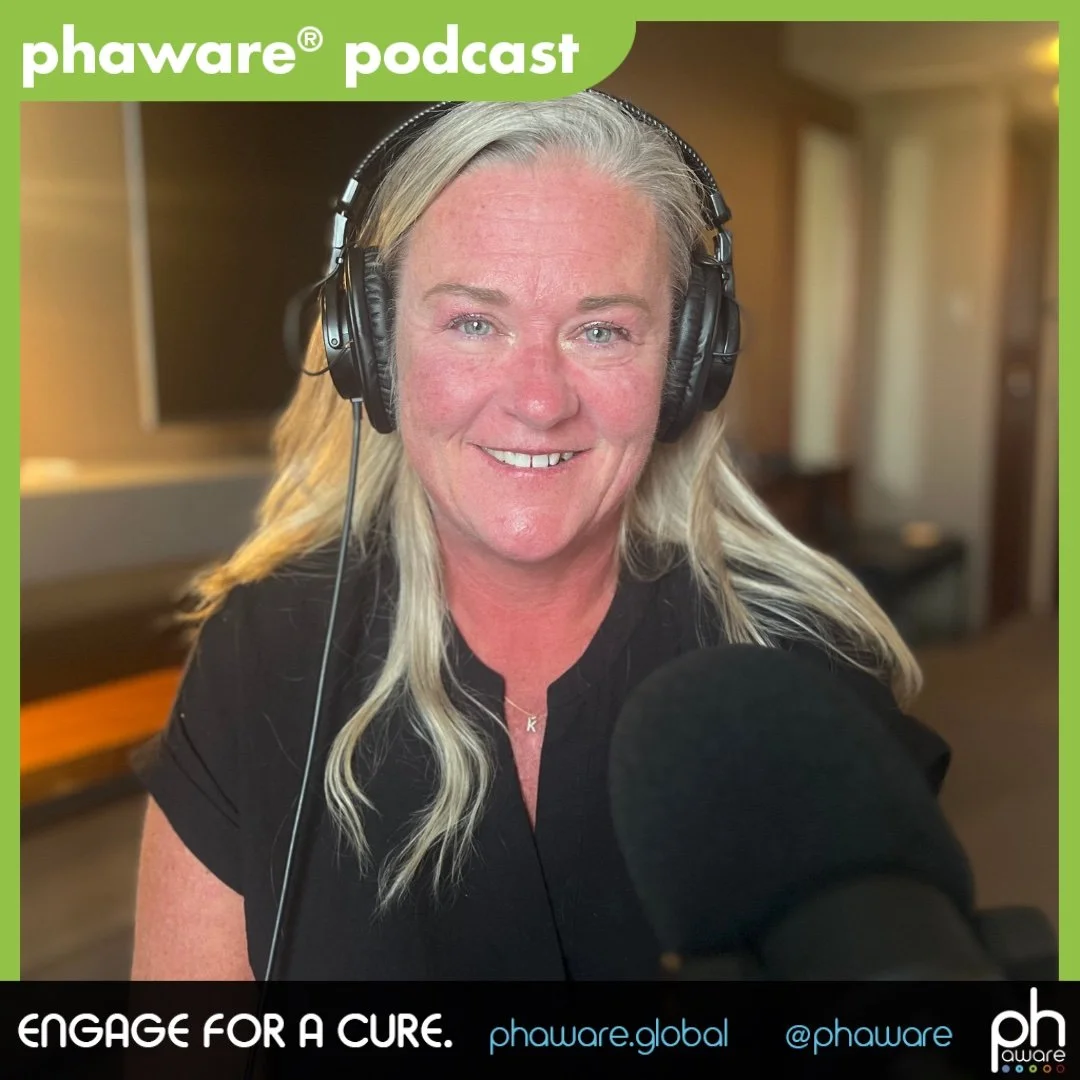
Episode 594 - Kirsty McGeown
Canadian pulmonary hypertension patient, Kirsty McGeown signed up to be an organ donor as a teenager, believing it was a simple act of kindness. Years later, Kirsty found herself sitting on the opposite side of that decision. Now, she’s focused on reclaiming life’s normal moments, holding onto hope, and dreaming of one day becoming a grandmother.
My name’s Kirsty McGeown. I grew up in the Toronto area, I live east of Toronto in Pickering. I have been a normal, active, healthy person my whole life until January 2022. That’s when everything went to the dogs. I got COVID and never got over COVID. I couldn’t walk. I couldn’t talk, which is difficult for my job, because I talk for my job. I couldn’t carry my lunch bag, I had to use a shopping cart to get in and out of work. I work for Costco. It got very bad very quickly. I was taken from work by ambulance with a blood pressure of 180 over 130, treated for high blood pressure, which I’ve never had in my life. I was referred to a long COVID study/clinic through Providence Healthcare, which is in Toronto. I was assigned an occupational therapist, a physiotherapist, all the specialists you could think of, respirologists.
We ran every test we could. They just kept saying, “Well, we don’t know the effects of people after COVID.” I had been vaccinated, because I was told my whole life I had asthma. I was a croupy child, so I was in and out of Sick Kids in Toronto, but nothing was ever diagnosed as a child. Then, as a normal kid, I played soccer, I played rugby in high school for years. I ran track. I couldn’t run long distances, but I was a great sprinter. Up until two years before I got sick, we did a fundraiser where we walked from Sick Kids in Toronto to our Costco in Oshawa. That was 53 kilometers we walked in one day. I did it twice in two years. It got to the point where I couldn’t walk five feet.
Finally, in January of 2023, I went to get my results from a respirologist. She said everything came back normal. There was no detection of asthma, but she said, “I can see you struggling to breathe.” She said, “We’re going to send you for an echocardiogram.” That was the beginning of January. February 9th, 2023, I walked out of work. I closed Thursday night. I walked out and I called my girlfriend, who’s my boss. I said, “I have a really bad feeling about tomorrow.” She said, “Only happy thoughts, only positive thoughts.” As I was laying there, very vulnerable in an echocardiogram with a gentleman, he said, “When was your last echo?” I said, “I’ve never had one.” He quietly said, “Oh.” I had looked at the requisition and the requisition had a little check mark saying, “If something’s detected, follow up immediately with a cardiologist.” I didn’t think much of it. He said, “Just have a seat, get dressed, have a seat right here.”
Within five minutes, a cardiologist brought me into her office. For about half an hour, she asked me questions, “Do I have lupus? Do I have AIDS? Do you have scleroderma? Do I have family history of anything? Was I a heavy drug user in the past?” Finally, at the end, she said, “I’m sorry to tell you, you do not have long COVID. You have a very serious disease called pulmonary hypertension.” At the stage I was at, she said I had about six months if they hadn’t have caught it. I was grateful that she caught it when she did. You read so much of it goes misdiagnosed for so many years and so many people. She said, “Buckle up, because things are going to happen fast.” Within a month, I had had a bubble study, because the echo determined a small ASD. Then, they wanted to do a TEE, a transesophageal echocardiogram, but because of my pressures, you can’t be sedated.
She usually does it in her office, but she booked an OR in the hospital. She brought in the specialist from Sunnybrook Hospital. He stood by me, I slowly went under. Then, I remember waking up. She said to me, “I’m very glad we did it here because you dropped and we had to bring you out quickly.” From that point on, I was referred to Toronto General Hospital’s PH program. Within six weeks of diagnosis, I was talking to the doctors at Toronto General, starting medication. We started with the first oral medication, Tadalafil. The side effects hit me hard. At this point, I was off work as well. I had to go off work within a month of diagnosis, because I just couldn’t emotionally handle it, physically handle it anymore. Luckily, I have benefits that I can go off. After about six weeks, just before we were about to start with the Ambrisentan, we switched to Sildenafil. It’s spread out through the day instead of one big dose in the morning. That eased few of my side effects, because I wasn’t getting better with the side effects after six weeks.
The summer went on, I went on vacation, did a little bit of walking, but not too much. Then, I just felt myself getting progressively worse. They started me on subcutaneous Remodulin. So, I started the training sessions in September through October. The nurse would come to my house. She would give me all the equipment to start with. I would practice with saline. I would hook up a site, hook up the pump and just run saline through it for two days just to get the feel of changing the pump and everything. November 1st, we started. Sadly, I changed my pump the first time, it was three days on the Saturday, and I forgot to disconnect the site from my body. I gave myself a month’s worth of Remodulin in five minutes, and an ambulance was called. My pressures bottomed out. The ambulance (team) were trying to figure it out, because I said, “You can’t disconnect me and you can’t give me fluid.” I gave them the nurse’s number.
The nurse talked them through how to handle it, because the first thing they do when your blood pressure bottoms out is they want to up your fluid, because they need to get that blood moving. I spent the weekend in ICU. That was a mistake. I was asked multiple times, “Did you do this on purpose?” I’m said, “Nope, just forgot to disconnect it,” because they just have to make sure that it wasn’t an attempt of sorts. I was on the SubQ for six months. Remodulin is offered subcutaneous or IV, and they like you to try the one for at least six months so that you know what’s going to happen. My son lives in New Zealand, he’s a doctor, and he would talk to me and he would see the pain. I became completely a recluse. I couldn’t even lay in bed depending on where the site was. My sites tended to fail quickly. They call it hell week. Hell week usually lasts, for me, two weeks. I would be lucky to get a week to two weeks.
Most patients have to go through the lung transplant process, the testing, all the questions. I have a palliative care doctor, which people are like, “But that means dying.” I said, “It also means pain management.” She’s fantastic. I also have an occupational therapist who, if you have a transplant, do you have a bathroom accessible, what is your house layout… All these things that you have to go through. It’s not like on Grey’s Anatomy where you come into the emergency room and they’re like, “We need lungs. Oh, here’s lungs.” It’s a whole process. I had to go and meet with physiotherapists, do a six minute walk with them monitoring more than a normal six minute walk. So many other things. Then, finally you have to meet with the doctor.
Dr. John Granton at Toronto General is my hero, my champion. They said, “Bring your support group,” so I walk in with my best friend since I was 12 years old, my best friend as an adult who is also my boss, and my son, and my other son on FaceTime, because he’s in New Zealand. They said, “Oh, you brought a big group.” He started explaining the whole transplant process. When I was 16 and I got my 365, what we call our learner’s permit, it was good for 365 days, you tick a box, “Do you want to be an organ donor?” That day I turned 16, I ticked a box, and it’s very surreal to now be on the other side, because I was always prepared to give my organs, and now I need someone’s organs. That’s really hard to accept.
It was probably the worst conversation I ever had to listen to in my life. Because I have pulmonary hypertension, I cannot be sedated. So, before you start, you have to go on the heart lung bypass machine. To do that, they do local anesthetic. If you survive that, then we go into the operating room, and then we open you up and we take the lungs out and we do this and we do that. “And then if you survive that…” I blanked, and my people saw that I blanked. My girlfriend, she sat typing the whole thing. Every word he said, she’s typing, typing, typing, because she said, “You’re going to want to know.” If you survive the surgery without rejecting, then you go to ICU. The biggest problem in ICU is delirium, because we leave you under, but you’re kind of under, and you can kind of go crazy, because you’re hearing things but not hearing things.
At this meeting, Dr. Granton saw how painful my site was. They switched me two weeks later to the IV Remodulin. So again, you can’t be put under for that, so it was all with local anesthetic. It’s not pleasant. So this meeting went on for about an hour and a half. It was so heavy. You have to know what can happen. The outcome you hope is that you’re fine, but you may not be. It’s not a green light to a happy rest of your life, because then come the problems with transplant and rejection and kidney failure from the anti-rejection drugs, all these things. So, knowing all that stuff, I actually feel better, because I am a worst case scenario person. So I like to know what can happen. Two weeks after that appointment, I went in, they switched me over to the IV Remodulin.
In March of ’25, we started on the miracle drug Sotatercept. It is an injection that you give yourself every three weeks. It can not only help with your symptoms, but in some cases reverse symptoms, which is unheard of in PAH. For the first shot, you get half a dose. I was like, “I feel better.” Of course, I’m thinking it’s all in my head, right? It’s the placebo effect. I said that to my son and he said, “Even if it is the placebo effect, you feel better, so take it.” Then, shot two came, and I felt better. After shot three, one day I woke up. Normally, for the last two years when I wake up in the morning, it’s a good 45 minute wake up process. I need to just sit up a bit, I need to stumble to the bathroom, come back, sit down. I need time to wake up.
Well, this morning I got up and I’m like, “I think I’m going to have a shower.” I got in the shower, without thinking about it. Normally, showers are like, “I have to shower,” because I have to tape off my line, I have to… All this work. I was in the shower and I didn’t sit on my shower chair. But you don’t realize these things till afterwards. I looked at my bed and I’m like, “Well, I need to change my bed this week.” So I stripped my bed and I walked to the basement and I put my sheets in the wash. I walked up the stairs and I went outside and I watered the garden. All of a sudden I’m like, these are things I haven’t done in two years, and I’m doing them and I’m not out of breath. Except headaches, very bad headaches.
So, we started titrating down on my pump. By titrating down on the pump, I’m able to hopefully get off the IV. That’s my goal, is to feel well enough to get rid of the IV. In the Facebook groups that I’m in, so many people are like, “I’m off the pump.” Let me tell you, the first thing I’m going to do is jump in a pool, because, man, do I miss swimming. It was hard not swimming this summer. But basically that’s where we’re at now.
My hope is that I can go away for my birthday. I have traveled. We went to New Zealand in February ’25 for my son’s wedding. That was an experience, taking all the supplies and all the luggage and everything, but it was well worth it. I’ve flown to Nova Scotia for my nephew’s birthdays. I’ve driven to Nova Scotia this summer. My hope is getting normal life back. People think I’m crazy, but I’ve been given the okay to go back to work, modified with significant accommodations. For my mental health, I need that, because I’ve always been a very social, very outgoing, very friendly person. This disease has turned me into a recluse. I used to never say no. “Do you want to come to meet me at the mall? Do you want to go for lunch? Do you want to go for a drive?” Now, I say no to a lot of it, because I just don’t feel up to it.
Feeling better, whether it’s placebo effect, whether it’s working, I know I’m getting the real drug, I know I’m not getting placebo, I’m feeling better. Six months ago, I wouldn’t have been able to talk this long without you knowing how out of breath I was. I’m getting a little breathy, but I’m okay and I’m feeling okay. I just want a bit of normalcy back. Even if it’s going to work, if it’s going on vacation, I’m never going to get better. It’s a progressive terminal disease. I have two sons, one’s engaged and one’s married. I want to be a grandma. That’s what I’m holding on for.
My name’s Kirsty McGeown and I’m aware that I’m rare.
###
HELP MAKE PH HISTORY
Learn More phaware.global
Listen & Subscribe phaware.global/podcast
Support the Movement phaware.global/donate
Share Your Story info@phaware.global
Get Our App phaware.global/heartworksapp
Follow @phaware · #phaware