I’m Aware That I’m Rare: the phaware® podcast
Episode 600 - Denise Sese, MD
Pulmonary hypertension care has entered a new era of breakthrough medications — but Dr. Denise Sese believes one of the greatest unmet needs isn’t another molecule. It’s helping patients truly understand their disease, navigate their lives, and reclaim hope after diagnosis.
She discusses why the next revolution in PH care will focus on helping patients live fuller, richer, and more meaningful lives through education, communication, caregiver support, and palliative care.
In this inspiring episode, she shares her vision for a future where physicians are trained not only to treat pulmonary hypertension but to truly understand the people living with it every single day.
This Special Edition episode is sponsored by Liquidia.
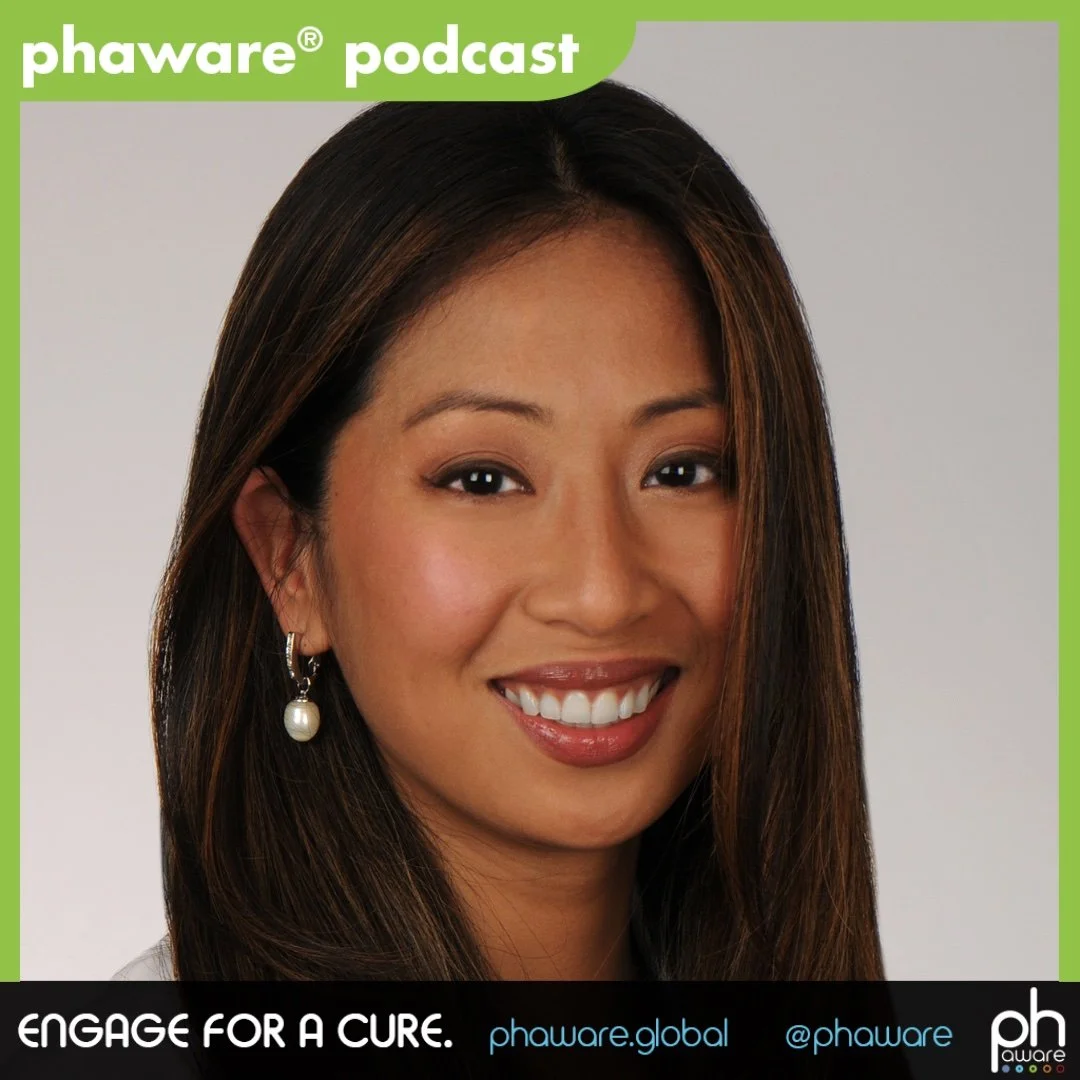
My name is Denise Sese, and I’m a pulmonary hypertension specialist. I work in the Medical University of South Carolina, but I had previously completed my training at the Cleveland Clinic, where I met my mentors and got interested in pulmonary hypertension.
When I was a resident, I was doing internal medicine, and you’re very interested in really everything. I did a project on RV failure called the DIVA study. We were looking at markers of dysfunctional right ventricles in patients with pulmonary embolisms. I thought this is so physiologically interesting. It’s hard to understand the right heart. It’s shaped weirdly. People keep misdiagnosing patients who have right heart dysfunction, even when it’s an obvious thing like a clot. I think that sparked my interest as a resident.
How I came to decide on pulmonary and critical care is I worked in a community hospital called Akron General that was in the process of being acquired by Cleveland Clinic. It’s a very ICU-heavy hospital, so all my directors of the program, everyone was ICU. We spent more time in the ICU than most other programs, and I fell in love with intensive care. I think that’s probably the story for a lot of people who start doing pulmonary critical care. You are drawn by this physiology on steroids. You get a dopamine hit from fixing the problem. You see a patient, they’re critically ill, you want to fix it, you do something, you fix it. You’re like, “Wonderful, great. It’s amazing.”
But one thing that I started to notice as a resident is it’s also quite terrible for these patients, and more importantly for their families. I also noticed that I spent a lot more time with these families than most people. I really valued sitting down with the families of patients, even when they were doing well. I loved visiting with families because understanding their perspective on what their loved one was going through was so interesting to me. I think that’s how I naturally transitioned into I think I need outpatient, because I like building those relationships. I don’t really like the one-offs. I see you, maybe I temporarily fix you, and I send you out into a system where you could just get sick again. I needed to understand my role in that.
Then when I was a medicine resident, I became chief resident. As a chief, I felt responsible for the education of my residents. I always knew that no matter what in my career, medical education would always be something I was passionate about. I loved figuring out how to make something really complex, really easy to understand because I didn’t really think I was smart at all. I said one day there are going to be other residents that may want to do something and they’ll feel intimidated. Maybe my role is to try to encourage them and say, “You really can do this.” I really believe that if you can teach something, you really understand it. That was my journey into pulmonary and critical care, and also medical education.
No matter what, I want to be teaching, so the ICU gives me an opportunity to teach the healthcare system and trainees, and then having a pulmonary practice helps me have that relationship. And then, naturally sort of fed into my future career because my research interest is in patient education for patients with advanced lung disease. When I became a fellow, I was a fellow at the Cleveland Clinic. I met several mentors that shaped my career. I was one of those fellows that just loved to learn, so I created a curriculum for myself internally. I said, “I don’t think that it’s enough that I try to learn about every single pulmonary disease from afar.”
If you somehow take care of a complex patient in the hospital or if you somehow end up observing the care of that patient in their pulmonary office, then maybe you’ll learn how to take care of them and then you supplement that by reading about it yourself, reading journals, doing research. That’s the traditional framework. I said, “That’s not enough. I feel like pulmonary education needs to be more hands-on.” As a second year fellow, I got all my attendings’ clinic schedules and I said, “The strength of Cleveland Clinic is in their subspecialty programs,” so I put myself in everybody’s clinic. Most pulmonary fellows actually try to avoid clinic, I feel, whereas I did the opposite.
I put myself in almost every clinic and I would recruit different types of patients. That way, at the end of three years, I thought I’d have a very well-rounded outpatient education. It was then I think that my mentor started to notice that I really liked education and really like teaching. My mentor is Kristin Highland and she is both a rheumatologist and a pulmonologist. She said, “I was thinking about the perfect project for you, Denise. I thought, why don’t we try to think about something that addresses what pulmonary hypertension patients know and what they want to know?” That was her homework for me. She said, “Go ahead and look at the research, see what patients actually know about their disease, and then think about how we would measure what they want to know, how they learn.”
I looked at what was out there and I saw there was kind of nothing. There are surveys, usually done in Europe, and the biggest one is the Global Patient Survey that came out in… They gathered the data in ’24 and 2025 to get patients’ perspectives on their disease, their treatment, what to do. You can go back to as early as 2014 where some of the Swedish pulmonary hypertension providers were integrating understanding patients’ perspectives in their clinic. They made it a priority to understand what do these patients want to know?
That’s very different from our model of care sometimes in the United States where it’s very prescriptive. When we see patients, we think, okay, they need to know X, Y, Z. When my mentor said, “Look at whether there’s anything out there about what they actually know,” I found out that there’s not a lot. I came across research in interstitial lung disease, which in particular IPF, idiopathic pulmonary fibrosis, it’s a disease that’s similar to PH in that it progresses, it’s severe, patients die a very terrible symptomatic death. I found the name of a nurse named Kathleen Lindell, but she’s a nurse researcher, and she created something called a Program of Support where she educates ILD patients in a class and teaches patient dyads, so a patient and their caregiver.
She teaches them things like what is your disease? What is palliative care? What are clinical trials? She created a learning program with a book, and she would measure their knowledge, their perspective. That was her research. I used that and I said, “Well, I’m a pulmonary fellow and I don’t have a practice yet, and I don’t have a grant. That’s going to take a lot of time and I won’t really know what they know. I won’t be able to measure what they’re watching, what they’re thinking.” So I said, “Why don’t I put it on a learning management system and why don’t I actually use videos?” I started to do research on video-based patient education.
Right now, the research for video-based patient education is in acute procedures. Say you have a colonoscopy, you’ve done it, you get a video, they’re like, “Watch this,” and then you know how the procedure’s going to go. In chronic disease like inflammatory bowel disease and in HIV, they’ve sort of dabbled into using video education to see whether patients can learn, and then they measure what they know before and after. I said, “Oh my gosh, this is perfect. You have a very sick group of patients who, if they don’t figure out what their disease is, you leave them and their families to figure out what to do with the rest of their life.”
I also then started to look at where do patients get their education? There’s a Living with Pulmonary Hypertension book that’s made by patients for patients. I read the whole thing, and then I looked at websites and I looked at the PHA, the Pulmonary Hypertension Association. I saw that you can access a bunch of videos, but some of them were too long. Some of them I thought might’ve been too complicated for a patient that was just starting out. I couldn’t really find where all the videos were. I think that these are all great resources, but I thought this is perfect because no one’s ever really asked patients, developed something for patients with adult learning principles in mind because that was my interest, medical education.
At that point, having done a chief year, having created curricula for my residents and for myself now, I kind of had a science to how to develop a learning platform. I thought, why not make something that would help these patients? So we, Dr. Highland, myself, the Cleveland Clinic team, and a patient made 12 videos that were patient-facing. They were about 20 to 30 minutes each. The topics came from the Living with Pulmonary Hypertension book and the topics that I saw the PHA was putting out, because chances were these were the topics important to patients.
The aim of the videos is to understand really what patients know, understand what they want to know, understand whether a platform like this was even feasible. I did a pilot feasibility study. When you do a pilot study like that, your intention is really just to figure out first, how does the thing work? What are the kinks? How can I make it better? And if I did it, would they even finish it? Would they like it? Would they do it? Just simply put. We called it SMART-PAH, Systematic Learning with Technology in Pulmonary Arterial Hypertension. You always try to retrofit an acronym somewhere. There’s a big M and a big A in the learning, so I made it fit something catchy.
The thought being that if I empower patients by not assuming what they know, because I can’t know what they know, they would be better patients in the long run, and maybe this was a good way to get that conversation started to get them at least educated in the things that they’ve said matter to them. That was the whole beginning of the research that I did. Along the way I had other mentors, Neil Chaisson, who is the program director at Cleveland Clinic, who’s also an education expert. Together, these physicians really influenced my career both in my research, but also in the style of teaching in clinics. Both of these physicians are pulmonary and critical care physicians, are PH physicians.
One day as I was trying to learn PH. A 20-year-old patient came as a secondary referral from some other state. Cleveland is special in that patients come there for another opinion, another opinion after they’ve been through lots of tests, lots of physicians. This young woman had already seen a couple of PH specialists, and she was on oral meds, but she was quite sick. She was passing out. She was functional Class IV, which meant she was short of breath even at rest, and she was 20.
As I watched that attending educate her, he was drawing the right heart, he was explaining physiology, and then he went through a checklist of items. Remember, she was coming as a second opinion, so this is her first visit. He said, “Oh, and by the way, these medications, they can impair a fetus if you get pregnant so we’re going to need you to be on contraception. And you can’t get pregnant and you can never have children.” He was just going through things as a matter of fact in a very neutral way. This young woman screamed so loudly and threw herself on the ground and started crying. I was really feeling for this young woman because this could be me.
She probably wasn’t hearing that he was talking about her life, her survival. She probably couldn’t even hear what needed to be done and what the next steps were. All she heard is, “I can’t have this important thing anymore.” That’s all she heard. I was observing how we had to walk her back and comfort her, and really try to see where she was because she was so upset. That’s really why I designed this. I said, “This is important.” I can imagine other patients not feeling comfortable bringing up things that matter to them, not bringing up things that bother their families. I thought, oh, this is really important. I’ve learned a lot from the study, but even before that.
I believe that a new PH diagnosis has an emotional arc. I think that PH physicians have to recognize that the messages that we send in clinic, our teaching agenda, our clinical agenda sometimes will not fit the patients, because we have to start recognizing where they are personally in their journey. Add to that, the fact that patients, by the time they get to you, you are the PH specialist. By the time they get to you, they’ve probably already been told different things from the diagnostic delays.
To this day, there’s about a two to three year diagnostic delay for a lot of adult patients. I’m not sure for pediatrics, but I would think it’s somewhat similar. Adults, unfortunately, are told lots of things before they get the PH diagnosis. They were told that they have asthma, they were told it’s in their head. Add to that that they’re female, so sometimes they’re told that it’s depression or anxiety, or they’re told that they’re fat. They come to you already mistrusting, because of their experience with the system. Then if you come to them with your agenda and you’re like, “Well, here’s what we need to do because you need to focus because you need to survive,” you lose that relationship opportunity.
I truly believe when you’re a PH physician, you have such a unique relationship with your patient. You always meet them at their worst. If you meet them in the outpatient, which is not always how you meet them, they’re already delayed and they’re coming to you feeling like they’ve gotten gaslighted. Here you are laying out a very emotional diagnosis that they have a disease that’s going to progress, that this progression, when risky, can lead to death. More importantly, that to stay alive, you have to be on a bunch of medications that you and your family is going to have to learn how to do. By the way, if it gets discontinued, you could die.
I think that when you’re talking to a patient for the first time, you have to recognize that their emotional architecture starts with shock where they’re numb or in disbelief. They won’t hear 50% of what you say to them. When you’re giving out diagnostic plans, laying out next steps, I know that when patients get home, they’re like, “They told me I’m going to die.” If you’re talking to a 20-year-old versus a 60-year-old, that perspective hits very differently. Then, they get through the fear and the grief. Maybe they’ll get angry like, “What did I do to deserve this?” Your younger patients are going to feel that way for sure, and then they and their families are going to adjust.
When I talk to a patient, the very first thing I do is figure out where they’re at. I truly think that my relationship with my patient is just as important as my competency as a provider. It’s my responsibility to know what’s out there, to know all the latest treatments, to know that I need to treat my patient and get them to the lowest risk possible, to be aggressive whenever it warrants it. But most importantly, I know it’s my responsibility to communicate properly with my patients. Communicating with people requires an understanding of your relationship with them and also their head space where they’re at. That’s certainly a skill that actually informed all my other future studies.
I think that your first meeting is about expectation-setting. That’s why you have to start with gaining an understanding of what they know. When you start with that, then you can address misinformation, things like drug treatments that work. Do they work? Do they not? If they’ve already read about drug treatments, you have license to talk about evidence-based treatments. If a patient comes to you with frustration like, “This so-and-so doctor made me feel bad…” Like the patient who told me, “They told me I was fat, how dare they?” What that patient is asking from you is comfort and understanding. They want healing right now. They want to be able to trust you.
What they don’t need is for you to tell them how wrong that person is. What they need you to say is, “I’m sorry that that was your experience.” When I’m seeing a patient, my priorities are set and informed by first what they know, and then internally I’m thinking what does this patient need right now? When I first meet a patient, I always tell them, “I know that your first visit can be overwhelming information-wise, so let’s just talk about what PH is and isn’t.” Then I have a speech about it. Normally, I describe the right heart like a cup of coffee and I say, “Imagine drinking coffee from a straw and switching out that straw to a coffee stirrer. Your vessels in your lungs are the coffee stirrer and the coffee is like your right heart, and your heart is struggling to push blood through.”
It’s imagery that I think most people that at least drink coffee can relate to. Then, it gives me a chance to draw for them. If I think that they’ll benefit from drawing some of these pathways, I’ll do that. Then, I talk about the two main goals of treatment in PH, which are survival and quality of life. I say, “Quality of life looks very different for different people. As we go on this journey, you and I,” I’m addressing the patient, “you and I will figure out what that means at different points in your life.”
I’ve learned you have to have a lot of compassion for what people are going through. You can only imagine what it might feel like. You’re never going to feel what they feel, so you have to learn to develop true compassion for the suffering that patients go through. It’s not just physical suffering, because they’re short of breath from their disease and limited in their exercise capacity because of their right heart. But they also have emotional and social needs that will maybe never be met or will always be at risk. It’s not as simple as saying, “Well, 50% of patients have depression,” and this number changes, or “50% of patients have anxiety because of their disease.”
I think more than that, it’s having a chronic illness, Managing that chronic illness really defines our patients and informs them sometimes of what they can and can’t do with their lives. I don’t like that. My goal is to help patients try to see past that and move towards having productive lives if I can. It’s taught me a lot of gratitude for my own life, because I think about what some of my patients say where they say, “Bending over to feed my dog is all I want to do.” Something that I find annoying, I don’t have a dog, but probably if I did, it would seem like a chore to me, but this is all this person wants to do and they can’t do it because they can’t breathe. That has to give you some sort of perspective in life about how hard these patients’ lives are.
When I decided to include a patient in my SMART-PAH, the patient that I included, her story starts in the ICU. I met her in the ICU. She was doing CrossFit, and she passed out during CrossFit, and she woke up intubated, had a cardiac arrest. She was 24. She had her whole life ahead of her. I was probably only four years older than her. I remember speaking in doctor speak to her parents about the risk to her life, what this means. I had such good intentions. Remember I thought, I know ICU. I can speak to patients and their families. Her mother got really upset. She said, “I don’t need to hear this anymore. I get it. She survived. Stop telling me that it’s good she’s alive and this and that.”
I got taken aback. I was so humbled by the fact that I thought I communicated my intentions well. When this patient woke up, she was about to take the bar. She had her whole life ahead of her. The only thing she cared about when she got to clinic was, “I can’t go to Italy with the rest of my classmates after the bar,” because apparently that’s kind of what you do when you’re waiting for your bar results, you travel. I said, “Oh, and there’s nothing in clinic that can teach people how to travel safely.” I asked the respiratory therapist, I’m like, “What do you give patients if a patient is like, ‘I have PH, or I have interstitial lung disease, or I have a lot of oxygen needs’”?
What happens if a patient is like, “Well, how do I travel?” They have to figure these things out for themselves. They have to rent oxygen, look at their destination, figure out how to ship oxygen over there, figure out what meds they need to pack, figure out that they need to call specialty pharmacy and ask for an extra shipment of meds. Those of them that are very organized will look up the emergency kit in the PHA and will even look up where they might need to go if they experience an emergency when they travel. So part of the inspiration for SMART-PAH was to help this young lady navigate her life. She signed up for the study and was part of my study team. She helped me develop it so that it was always grounded in patient perspective.
The first part of the study, which was the quantitative part, I could watch what they were watching. I could see what they were clicking. I could see which videos they clicked first. I could see how long they were taking to watch certain videos. I could see which topics patients wanted to learn about the most. Then she did the qualitative arm. A qualitative study is where you use methodology to study a phenomenon to say that it’s real. Because if you’re studying behavior, who’s to say that a behavior or a response is real? But if you have the same type of response and you analyze people’s responses in a methodologic way, and the same themes come out, then you can say, “There’s some gravity to this.”
What patients tell me they feel, this is a real thing. What patients say they don’t get, this is a real thing. What patients say they still need from their doctors, this is a real thing. How SMART-PAH, a video-based learning program, what it does for them, what they say it does for them becomes a real thing. This became the tool that I hope to use as a future PH physician.
When I made this course, I thought about what was most practical. For example, the video on sex and intimacy doesn’t just say you can’t have sexual intercourse as a PH patient. It says if you are going to have sexual intercourse, it’s important to recognize that your body has limits, that your oxygen needs to be put in a place where the cord doesn’t get tangled, that there are some sexual positions that may be off limits to you, but that shouldn’t get in your way. It talks about how if you want to have a biological child, that you may want to bank your eggs, but that banking your eggs might mean hormonal therapy and that puts you at risk for clots.
It also talks about how if you were to adopt, and this is something a lot of people still don’t know, that sometimes if you’re too sick, a social worker that comes to assess your life and says, “Oh, you can’t adopt because you’re too sick.” That’s a possibility. Designing this course really was so nuanced. We thought about really whatever questions they might have. What was really interesting is there were five videos that patients spent twice the amount of time on. The videos were what is pulmonary hypertension? What is the disease? That was video one. Video two was how do you get diagnosed? What tests do you need? Video three was therapy. What do the treatments do? What are the side effects?
We talked about emergencies and pulmonary hypertension, like over-the-counter drugs. What is a PH emergency? What is something that requires an immediate trip to the ER, sex and intimacy. The video that patients spent the most time on was insurance and finance. That also came out in the qualitative portion of the study that patients are under-supported by healthcare systems when it comes to their disability and their productivity. This turned out to be a huge thing. We looked at patients who were newly diagnosed, meaning they had PH for less than a year, and we looked at prevalent patients who had PH for more than a year.
The people who have had PH for a long time that said, “I go to conferences, I read journals,” Even they said, “I learned a lot from this, but more importantly, I wish I had this when I started my journey. It would’ve alleviated a lot of pain.” The insurance piece was quite interesting to me because it was about their finances and getting oxygen approved, and the legalities of having a chronic disease. When I made it was with myself in mind selfishly, thinking one day when I become a PH physician, I want to be able to support my patients in this way, but also I want to be able to give them something that they can use at home, they can repeat, they can use to share more information with their families, because a lot of patients actually say they feel quite invisible with this disease because they’re young.
The young women that get diagnosed say, “Hey, if someone has cancer, you have a lot of sympathy and empathy for them. But if I look as good as I do, people are like, ‘Really? You’re sick?’” This tool becomes a way for them to communicate some of their struggles. If you have an empowered patient, then they can figure out how to achieve their goals. There’s just not enough time in the clinic visit sometimes to go over what else they need to do.
We actually did a study on shared decision-making and how different it is for patients and providers. For most physicians, shared decision-making is a conversation about risk and benefit of treatment options, and that includes clinical trials. As a provider or a physician, you’re thinking, I tell you what I think, now you tell me what you think. Now remember, earlier I said the insight that we got from the study on medical education tells me that patients don’t always absorb everything you say when they’re worrying about other things like how to stay alive, how to stay up-to-date with managing their chronic illness, how to continue to work.
When I think about shared decision-making from their perspective, given the study we did on it, I have to understand how their social circumstance influences their decision-making. I try my best to lay out in terms of hopes, so when I’m communicating with a patient, I use patient-centered language to express what trials have done. For example, STELLAR is a new study. For physicians, it was one of the pivotal trials on sotatercept, the new active in signaling inhibitor drug, which showed improvements in hemodynamics, six-minute walk distance, and certain other physiologic endpoints of the right heart. When you’re talking to a patient and you’re like, “Oh, this many patients were studied. We knew that the drug was safe,” it may be better to say, “What this drug showed is patients could walk the length of a grocery aisle more than a patient who was not on this drug.”
How you would say that in physician language is there was an increase in six-minute walk distance that was statistically significant. What is that? 30 to 40 feet. When you say that to a patient and you’re talking about pulmonary vascular resistance cutoffs, a lot of times patients will nod and go, “Yeah, yeah, that makes sense.” Then they’ll go home and Google this or use ChatGPT these days to say, “What did that mean?” If they remember. When I do shared decision-making, I already incorporate making sure I give it meaning to them.
Say I have a patient that is still working. It’s a very different conversation from a patient who is sedentary at home, can’t walk to the mailbox, because if I say you cannot walk up and down the grocery aisle, what that means for them is they can start doing things for their family again. For a mother, that might mean having the energy to cook meals for your family. That’s really empowering for someone that’s in the sick role. To some families, that might mean nothing, but to a woman whose identity is, “I take care of my family and now I’m sick and I can’t do anything,” that’s huge. I think about those things when I do shared decision-making. I think about who they are and then what these trials might mean for them.
I verbalize it in terms of hope. I say, “My hope is if you participate in this trial that you might be able to do X, Y, and Z.” That way, I’m not promising that they’ll achieve something, but I am hoping, because I really am hoping that they can achieve X, Y, and Z. It gives them the opportunity then to tell me what they’re hoping for so we have clear expectations of what they hope for. One of the things that I notice is when you kind of just tell them, “Here’s the trial. Are you interested? This is also helpful to other patients,” a lot of disappointed patients, the disappointment comes from mismatched expectations about what they thought the trial meant to do. “Oh, I thought this was going to cure me. Oh, I thought I was going to come off oxygen if I participated in this trial. Oh, I thought I wouldn’t end up in the hospital anymore.” That’s sort of how I discuss things.
I always involve the primary caregiver because it actually helps me tease out the dynamics in the family. It’s situational. A younger patient who’s been sick, say they were diagnosed as a child, have a very different relationship with their parents where they’ll probably defer a lot of decisions to their parents. You can observe that in your clinic visit. They’ll look at their mom and dad like, “Is this okay?” But I try to help them along too by making sure that that visit is an opportunity for them to be heard. So doing it with all the stakeholders, and it’s the family, they’re on this journey along with the patient. Sometimes patients aren’t also empowered to speak up in their own families, so I use the visit to help almost provide therapy for the whole family.
I sit down and I say, “Okay, so you know how I said, what is your hope in participating in this trial? Or what is your hope in starting parenteral therapy, IV therapy?” It gives parents an opportunity, or children actually. If you have an older set of patients, children will speak up and say, “Mom, you need to live. I need this, I need that,” and then it gives their mom an opportunity to say, “It’s just me and your dad, and he’s frail and he can’t see. I really don’t think I can do this.” Then, I bring them together and I say, “All right, well, I hear that this is what you’re hoping for, but this patient is hoping for this.” I certainly think that it is crucial, one, to identify a primary caregiver, but two, to always educate the patient and their caregiver.
So when you’re talking about trials, potential therapies, or change in clinical status, if nothing’s working and the patient actually is not doing very well, you don’t want to have that first contact with the caregiver at that time, because you haven’t built trust with them either. This is a journey that you take with the patient and their families.
When I started at MUSC, one of my biggest missions was really palliative care. The SMART-PAH, it was partly a project to move forward my mission, which is to incorporate primary palliative care in the care of all patients. Because the way I see it, if you get diagnosed with PH, you have an advanced lung disease that either leads to progression to death or transplant, never cure.
By nature, you have a chronic progressive illness. All patients then meet criteria for palliative care, but patients are so afraid of it, because when they hear about palliative care, they think, oh, you’re giving up on me. This is hospice. Why? Why would you bring that up? It’s also harder to bring up with young patients, even if they’re not doing well. You have to recognize you are hoping for better outcomes even when you can see clinically that a patient isn’t doing well. At MUSC I said, “Well, how do I improve this? What do I know about this?” That’s really majority of my research, in palliative care and PH.
So we did a project called Tales of Living and Dying in Pulmonary Hypertension. It’s called TOLD, and basically we interviewed the families of patients who have passed away. They all had to be on a prostacyclin, whether it was subQ or IV. We wanted to know what the death was like for the family members, because the family members are left holding really everything. They’re hoping for survival. They’re helping their loved one get through the day, get through their treatment. But the worst part is when things don’t pan out the way you hope, you have to have those expectations set. It’s the family members that really suffer.
We looked at the framework of the family’s experience of death, because the other thing that really bothered me is our patients can’t die on hospice if they’re on prostacyclin. I thought that’s terrible. Not only do we take them out of their productive life, don’t support them, but if a patient of mine wanted to die at home, they can’t. They can only die in the ICU. I wanted to know why and what I could do to fix that. The why is a structural problem. Hospice will only pay for the hospice benefits. The assumption is, well, you’re actively dying and anything that sustains your life is not hospice-eligible or it’s not within the hospice mindset.
I thought, but you’re dying with your PH, sometimes from your PH, because if you pull away PH therapy, you are removing the opportunity for a comfortable death. I thought that was terrible because you couldn’t, as a healthcare system, support these patients with a hospice benefit as they die because hospice can’t pay for the prostacyclin medications. That to me was a terrible thought. That’s why we did the Tales of Living and Dying as a result of that.
In MUSC, we created something called a Hospice Runway where we partner with hospice agencies. We find ways as an institution to get the drug paid for, and then we gently walk patients through the process of getting off their prostacyclins the same way we walk them through getting on. If you get started on a prostacyclin, I give you a titration plan, why can’t I do the same thing as I wean you off so you can have a comfortable death?
I’m hoping to give you insight on how important I think caregivers and family members are. I know that when patients pass away, even to this day, many of my patients’ loved ones, they still pop into my clinic and they still ask for a hug. They are part of this journey just as much as the patients are, but there’s not a lot of research done in the space that I’m in. This type of research, it takes a lot of time to be thoughtful.
When you think about clinical trials, you’re thinking about molecules, you’re thinking about new drug treatments. Now, it’s nice because you’re also thinking about wearables. There’s a lot of interest in activity tracking and sleep quality, how to give patients back function. But there’s not been as much interest in this as a clinical trial when you very well could design a randomized control trial looking at this type of care versus usual care to see if things get better, or upfront palliative care with patients. Especially if it’s introduced by your PH physician who you trust with your life versus regular care.
I would love to see us move towards including these types of studies as important, because if you go back to the 5th World Symposium on Pulmonary Hypertension, they actually reframed the two main goals of PH therapy. The two main goals are survival and quality of life. You hear it all the time, but they reframed it and said, “We are going to improve how patients feel, function and survive.” With the new drugs, we have pushed survival out and people are surviving more. There’s not actually a lot that improve how patients feel. They feel better when they’re more functional, but the rates of depression are still the same. Their perception of their illness is still the same. Their functionality may still be affected by things that are beyond their physical improvements.
No one’s really done much for that other than to say, “Well, maybe you need a therapist, maybe this is a problem,” maybe they need palliative care. That’s where I hope to exist. That’s what I hope to push in my career. That’s really the space I like to exist in. I am hoping that more people find this important, even if maybe it’s not as sexy as the next big vaccine or molecule.
I spend a lot of time thinking. I like to sit there and think about myself, like everybody else, how can I be better? A lot of the projects I choose to do have to do with my limitations as a physician, my limitations in my skill, my limitations in my ability to communicate. That’s always informed the things that I want to do. I actually recently come to realize that the PH physicians, we don’t get a lot of training in handling how we talk to patients. Yet how we communicate with them is so crucial to their success. We think that our ability to communicate in intensive care settings where I can tell you, “Hey, if we don’t do this, you’re going to die.” Or we say, “Hey, if we continue to do this, this would prolong life without any added value.” We can say things like, “Death is just a moment and dying is a process.”
There’s a lot of ways to do ICU-related care, but so much of PH is gray. So much of the patient’s experience starts out with someone telling my patients, “You are going to die. There’s no treatment for this. This is terrible, you’re fat and you’re de-conditioned.” So much of their story is that. I come in and I have this perspective that I’m going to make it all better when in truth, we’re doing great things. We don’t know how well a patient is going to do. We don’t know what their journey is going to be like. We don’t know midway into your relationship with them, they get pregnant accidentally. We don’t know how to handle these things when patients look to you and say, “What do I do?”
You have to pull your ICU hat when that ICU hat, it’s not a good hat to have when you’re having these conversations with someone in the outpatient about things you’re not sure of. As I think about that, one of the things I’m hoping for is that more and more pulmonary hypertension physicians maybe begin to think about how that impacts us psychologically. Maybe we need a call to arms to train us to be better communicators. I’m sure many of us are good communicators. I won’t speak for anybody but myself. I recognize that I had a lot of room to grow, but you can always be a better version of yourself.
My hope is that I can create something for PH physicians like me so we can be better with patients. That’s probably the next step is, again, another curriculum, but a way to educate us so we can be better physicians for our patients.
My name is Denise Sese, and I’m aware that my patients are rare.
###
HELP MAKE PH HISTORY
Learn More phaware.global
Listen & Subscribe phaware.global/podcast
Support the Movement phaware.global/donate
Share Your Story info@phaware.global
Get Our App phaware.global/heartworksapp
Follow @phaware · #phaware