I’m Aware That I’m Rare: the phaware® podcast
Episode 599 - Kelly Dickson, RRT, RCP
What started as an unexpected career change became the role Kelly Dickson never knew she needed. Leaving hospital burnout behind, she found purpose as a pulmonary hypertension navigator, guiding patients through one of the most frightening diagnoses imaginable while discovering that sometimes the right path is the one you never planned to take.
Kelly wears countless hats: educator, coordinator, advocate, cheerleader, and trusted guide for patients. She reflects on the unexpected journey that transformed not only her career but also her understanding of what it truly means to care for another person during the most vulnerable moments of their lives. @AnMed_Health
This Special Edition episode is sponsored by Liquidia.
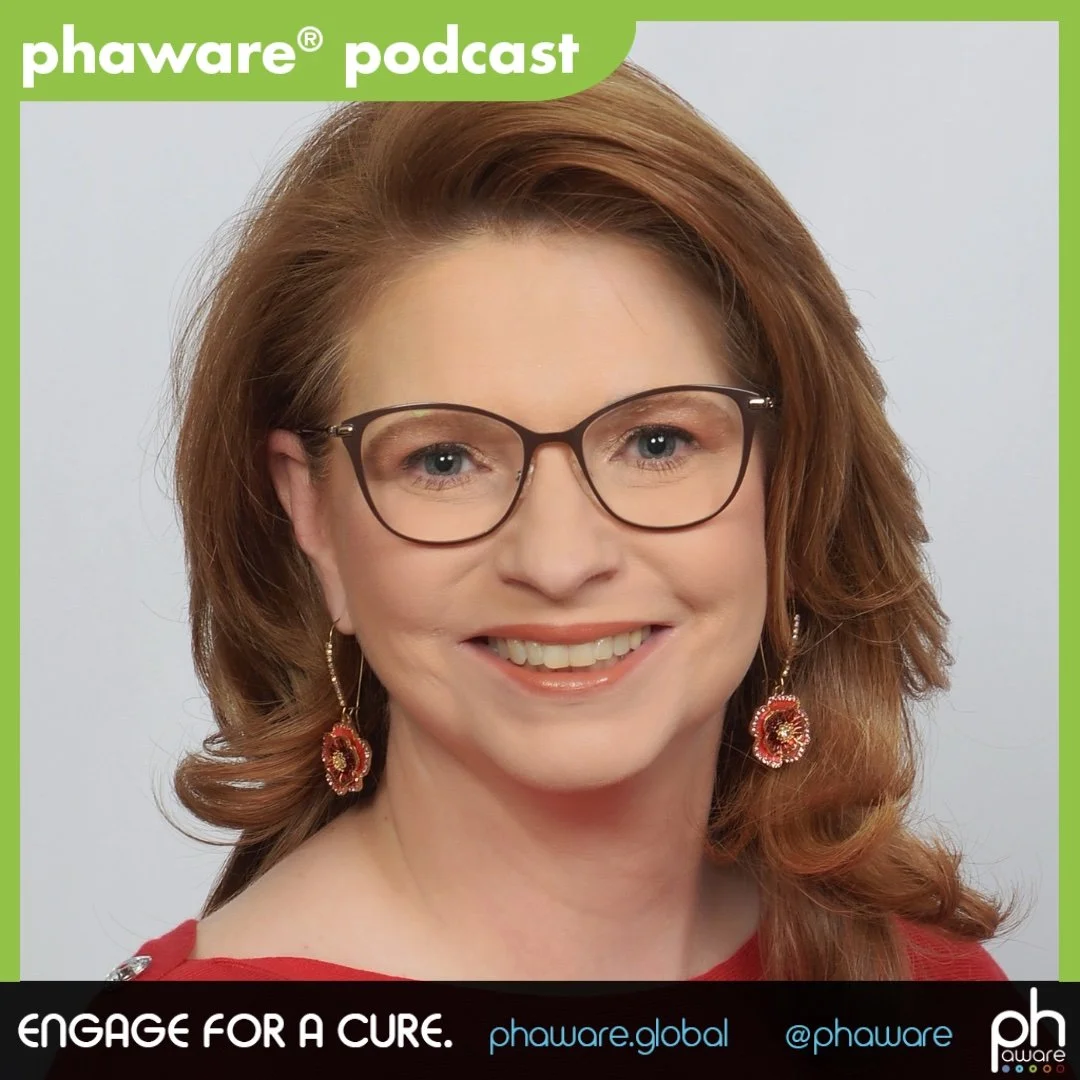
My name is Kelly Dickson. I’m a respiratory therapist out of Anderson, South Carolina. I work with AnMed Health Organization. I worked in the respiratory space for a number of years inside the hospital and then, at one point, they started doing respiratory and nursing homes, went to there. Then that went away and I came back to the hospital.
I worked on third shift for good a little while and then went to first. When I went to first shift, they started a bronchoscopy team. I worked in that space for a little over a decade. Then, I started getting burned out and I was looking for another opportunity. I came out to our outpatient center, which is the AnMed North Campus. Within a couple of weeks of being out here doing outpatient testing, pulmonary function tests, six minute walks, that kind of thing, the person who had been the PH navigator decided to put in his resignation and he started working with one of the pharmaceutical companies.
I put in for the PH navigator position and got it. It was like really fast process. I never thought that this would be the best opportunity I’ve ever received. I tried my best not to take it for granted. I love working with patients. I have the best of both worlds. I can do outpatient, come into my office on my own and then I do get to go back over to the hospital. I do education. I see patients with Dr. Abhijit A.Raval in the Right Heart Cath Lab. I do the nitric oxide challenge. I see patients down in the office with him. It’s just been a really great opportunity that I’ve just absolutely loved and didn’t realize what a wonderful transition it was going to be. I started doing this at the end of 2019. We’ve been here ever since.
I think being a respiratory therapist is an important factor because we work with patients who are having breathing problems and pulmonary hypertension is not necessarily about breathing, but the heart and lungs, they work together to be able to do what they do. I’m not going to sit here and tell you that I knew everything about pulmonary hypertension before I came into this. I still don’t know everything about pulmonary hypertension because it’s a varied subject, but I’m understanding it better. The more you go along, the better you understand things. If I saw somebody in the hospital that we were doing treatments with or a bronchoscopy on, I may have not necessarily put the whole picture together and understood what they were going through, but through this, you can really see the struggles people face with pulmonary hypertension because in a lot of ways it is a silent disease process.
If you’re handicapped, say you have a limb that’s lost, people can see that. But with pulmonary hypertension, it’s not always visible. It’s very important for people to have someone fighting for them in their space and helping to raise awareness and understand better. They probably struggle, I’m assuming, because I’ve had patients who struggle to communicate that with family and friends and for them to understand what they’re going through. So it’s important to have somebody on your side. I hope that I’m on their side and that they see that.
I think with pulmonary hypertension compared to what I did in the past, I don’t necessarily always have to do the same thing. I see more patients one day compared to another. There’s a little bit of a mixture of stuff. It’s not like I’m always going to give treatments or I’m always going to do bronchoscopies when I was on the bronchoscopy team. Even that can be different at times. It’s more self-paced at times. I don’t have to go run, run, run, do, do, do everything that’s a time crunch. But then at the same time, this can be a little bit of a time crunch depending on what’s going on, like if you have a patient who needs medication quickly. It’s more about what you make of it for pulmonary hypertension in my space.
I don’t know about other institutions. Everybody does something different. That’s what’s great about going to the PHA and to the PHPN (conferences), and talking to others you can find out how they do things, what their workflow is like. Coordinators here in South Carolina are very communicative. We all talk to each other. Today, I just got an email a little bit earlier from Sarah at Prisma. I talked to Sandra in Columbia, and then Christine in Charleston. We all have conversations going. Because their institutions work a little differently, I love to learn from others and see what they do.
I learn from my patients. I have patients who have been in the PH space for a long time and they teach me something new every day. I have a patient’s wife. She’s the one who really controls his medication and she’s taught me a lot. There’s always some new discovery. I feel like you’re kind of on the front lines in some respects with this particular healthcare because there’s something always new coming out. There’s always a new study. In some ways it’s very unique in this space because we’re all very concerned about our patients, wanting to make sure they get the best treatment possible.
When you’re in respiratory, you’re kind of like in a cocoon in that hospital. You don’t necessarily get out and branch and see other people unless you’re going to a convention and not everybody does that. You probably know people who are working at other institutions. It’s not like you’re invested in seeing what they do or how they do things because basically you come and do your job and go home. That’s not necessarily a bad thing because that’s got a lot of advantages, but with pulmonary hypertension, you take it with you wherever you go. You get a call off hours and somebody needs something. So you’ve got to be able to adjust. So I do think it is unique.
When I first came into this space, I knew very little. I can’t tell you how wonderful it was for the industry professionals, the people around me, Dr. Raval, they were just all so wonderful in helping me learn and not looking at me like I was a crazy person or like I had lost my mind when I would call them and ask questions. I just needed help. They have always been so gracious and so lovely. It’s just a close-knit community. It’s like a family because they’ve just all been wonderful to work with.
We don’t have a lot of younger patients. Our patients are mostly older. We have a few younger, but mostly older folks. So when you’re going through those life changes, as you get older, you’re slowing down. You may be gaining a little bit of weight, your activities change, you don’t have that energy. So when most people start noticing like probably fatigue and shortness of breath to begin with, and a lot of our patients have other comorbidities. They may have COPD or asthma or something like that. It gets pushed off into another field.
They just think, “Oh, this is what it is. My asthma’s acting up or COPD or I’ve gained weight.” With women, we had a patient come in and do a video for us for pulmonary hypertension awareness month in November and she’s in her early 50s. It’s on Facebook. You could actually go look at it on our Facebook page. But she was starting to go through perimenopause. She was getting older. She had been having symptoms for about a year when she had a real big episode. She was a very active person before. She was just getting older. She gained a little bit of weight. She was possibly in menopause, hormones related.
For men, it might be a little bit different. They probably pushed through. But then, when they just can’t push through anymore, then they have to find help. I think that that’s the worst part about it. They’re trying to figure out what’s going on. But then, I think that not just them putting it off, they don’t want to burden anybody and have them think that they’re just complaining.
If they go to their doctor, they’re given an inhaler, until it’s finally, you can’t blame anything else or when the fatigue gets so worse, they can barely go to the bathroom or they lose their breath just standing up from the chair. They just don’t have a life. I think that’s probably the worst symptoms and signs. Then, it just progresses. They finally have to find help.
Navigating the complex side of pulmonary hypertension with patients can be difficult at times because they come out of the catheterization lab and they’ve gotten their diagnosis, and then you’ve got to sit down and talk with them and let them know that they’re fixing to have an even bigger life change because they’ve got to be placed on medication. Sometimes, it’s unfortunate, but probably the majority of the time we’re hitting them with a lot of information. So you do your best to take it slow and help them to understand and let them know that you’re going to be there.
I make sure that they have my information so they know to call me them or their family members. I let them know I’d be happy to answer any question they have. If I don’t know the answer, I’ll be happy to find it for them. I try to put them in touch with the resources they need to be able to research on their own in a positive manner without going down a rabbit hole, because that can be difficult if you get down the wrong rabbit hole on the internet. But mainly just trying to be there and talk to them and be a caring person, because there’s just not really any other way to deal with it because they’re fixing to have a major life change.
They would love to get back to their normal. Unfortunately, a lot of times they are not going to get back to that peak normal. They’re going to have a new normal and that can be difficult a lot of times for them to understand. Dr. Hunter Champion came and did a PH support group for us, I think it was two years ago. He gave me great information at that time. He said that when he talks to patients, he tries to understand what their goal is, what it is that they love they want to get back to? They try to achieve that. They might not be able to go out and run a mile or whatever. If they were doing that before, that might not be where they get back to. But if they’re wanting to be able to garden or be able to enjoy their grandchildren and play with them, then that’s what’s the most important thing. So they’re trying to get them to the level where they can have joy in their life and make sure that they are having a good quality life.
I didn’t start our support group. Our support group was started by a lady named Tina Lisenby. She was the support group leader for many years. She passed away suddenly in February of ’23. She had been in the hospital and I saw her on a Wednesday and she was doing okay at the time. So I went up and saw her and I was like, I knew we had a support group coming up. So I asked her, “Tina, what can I do to help you?”
She told me what I need to do, told me to get in touch with Abby Sickles at the PHA and who the speaker was and the sponsor and all that kind of stuff. Then, Friday evening, that following Friday evening, she passed away, unfortunately. At that point, I took over the support group. I know it’s really supposed to be more patient-led. We are a small group and I do have patients who come to support group that would be happy to help in any way they can and they do offer. They haven’t wanted to take the initiative and take over. So I’ve just kind of just been doing it.
We meet about every two months, so about four to five times a year, depending on what’s going on. It’s been a blessing. It’s been a true blessing. I didn’t realize how hard Tina worked. You don’t realize all the details, because at the time that she was running it, I would come to some meetings infrequently. Then COVID hit right after I started this job. I mean, honestly, until you do one, you just don’t know all the things that go along with it. You have to go through the training and stuff. So I have a new appreciation for the support group leaders in the area and how well they are doing. Just to be able to keep that up and keep going and to keep it fresh every time and be able to be there, provide that service for patients who love it.
We do have a couple of people that come from further off. We’ve had a couple of people come from Columbia, a few times. We have one lady that comes in from Asheville. She doesn’t come every time, but she does try to come as much as possible. It’s been a really great experience.
I do think it’s important for patients to have a support group and a support system period because they need that community. It’s very important because a lot of patients can feel isolated in their disease, but it’s difficult for them a lot of times to be able to go places and do things and not feel like they’re being looked at differently, feel differently about things. I think that’s just important to have a community period. It’s good for your mental health just to be able to, number one, to get out of the house, have a new environment to see. They’ve always been a great support to me too. Everything in this field is more family oriented to me, I feel like. You get to know people, you get to know their children, you get to know about their pets, different situations. You just get to know them better. I don’t know. It just means something to have that community outside of a doctor’s office.
We started our walk in ’24 and we had our third walk in April of this year. It actually did start as a memory of Tina. Her family had come together and gotten money that they donated for people with pulmonary hypertension in our area. So we used that money as a catalyst to start the first walk in ’24. I think I’ve learned something new every year because, again, it is all about community and bringing people together and bringing awareness to the space. I’m a little bit kooky sometimes. I do videos to help promote the walk. Last year was probably the best walk as far as attendance and raising money.
Dr. Raval, he got us an interview on the Fox News channel to be able to help promote it. We try to offer something every year a little bit different. One thing we did learn from that first walk is a lot of people in our space, they can’t necessarily walk around the track. So that next year, we tried to incorporate pulmonary rehab tents so they could do chair aerobics. That was very popular. We’ve done that now two years in a row. We’ve increased our patient’s experience by having more local sponsors. We’ve been able to get more local sponsors. PH kind of crosses over into other spaces too, like with asthma, COPD, sleep apnea, different things like that. So trying to get more vendors here in those different spaces that cross over with pulmonary hypertension for next year. We try to have a goal each year to reach and make sure that they have something new and special.
I don’t want people to come out here and feel like that they are not part of this event, when we do a walk, because we are doing the walk for them. Even if they can’t walk, just come out and join us. Last year, we had a couple of people come out and they brought their chairs and sat under one of the tents, because they couldn’t walk. They couldn’t really do the chair aerobics. But they came and were a part of it. It was such a blessing to have them come and be a part of it, because that’s really who we are representing, those patients who need to be seen and they need to be understood and for people to understand what it is that they are going through.
They may look like they can get up and walk around the track, but they honestly can’t because they get out a breath, they’re too tired. We want people to understand and to know who we are raising awareness for and who we are representing.
My office is in the pulmonary rehab space. I’m not in the doctor’s space. I’m in pulmonary rehab space. So I help out at times with six-minute walks and blood gases and stuff and literally we have people that come in here, they have to be wheeled into the building. They cannot walk into this building. They come up here to do a walk and they’re having to be wheeled over to our area to do the six-minute walk test. Their blood pressure may be too high, just different circumstances. They might not be able to do the six-minute walk test.
But then once they are on drug and they are established on drug, I have seen them literally walk. It’s just the transformation is phenomenal a lot of times. Just being able to see them, be able to get up and actually do stuff and to be able to, I mean, just to function. I mean, literally just to function. To walk into this building and be able to get into the doctor’s office and not have any bad side effects or experience what they were experiencing before.
I have a patient, she spoke at our first walk. She is a Special Ed teacher, love her. I don’t think she mind me telling you this because I’ve told it before at the walk. When she got diagnosed, it was like it hit her like a Mack truck. She got diagnosed with a couple of different things. At one time, we had to start her on SubQ (subcutaneous) therapy and it just really hit her hard.
She would come into the office. This went on for a little while after she got on therapy and everything until she got to a point where it was getting into her body and doing what it’s supposed to do. She would stand up with oxygen on. Her oxygen saturation would just plummet to the bottom. And number one, she had to be wheeled into the office and she just couldn’t really function. But now she’s still wearing oxygen, but she can walk into that office by herself. She’s not having to be wheeled in. She just has come so far. She can do a six-minute walk. She can’t walk all the way around the track. She can walk part of the track. She’s done our pulmonary rehab program. She’s just phenomenal.
I had a patient the other day, I want her to speak at our next walk. She was telling us, she was just in such good spirit. She was so positive with just great energy coming off of her. And she was like, “Yes, next year it’ll be 15 years.” I was like, “15 years? Are you kidding?” I was like, “You’re going to have to speak next year’s walk.” I was like, “You just don’t know. That’s a phenomenal story that you’ve been dealing with this for 15 years.”
We have patients that have been diagnosed for a number of years, over a decade. So you just don’t realize it until you really talk to them how they’re doing and how well they’re doing and how long it’s been. I have another fellow, he works a full-time job, he’s not retirement age or anything. He just runs circles around you. I got a couple of fellows like that. They just run circles around you. They are so good. They’ve one really well with their treatments. They’ve been really good about making sure that they take their medicine and that they’re staying on task. Just phenomenal patients that just bring a lot to the space and a lot of inspiration.
Those kind of stories, you find out, because you put them on medications, and sometimes they have to go through those side effects until they get up to the point where they’re doing well. Those stories are just so good to hear. Sometimes you go through those days where all you hear is negative and when you hear that positive, it can take you for a while. It can send you into next year, because that’s what you want to hear because then you feel like you’re really making a difference when you hear those things and you see how well patients are doing.
If this is what you’re interested in, learn more about pulmonary hypertension. Research what it is. Find out more about it. Talk to the patients that you see on a daily basis, find out what their struggles are, what it is that might inspire you to help them. Reach out to your pulmonologist, or cardiologist, fellow respiratory therapists, or the nurses who are in this space and find out what it is that motivates them and why they love it and see if it’s just something you want to tackle, because we’d love to have you.
There are so many things coming on the horizon. There’s just so much hope. I know that it’s maybe medication based, but there’s just so much hope out there that keeps on coming. The studies, the research is just phenomenal. There’s so many things that are coming down the pipe. It’s not here yet, but just hold on. It’s coming. Make sure that you get checked out. If you think this may be something that’s going on with you, get checked out. Seek help. Don’t give up. Be your own advocate.
If you are having issues and you’ve gone to the doctor and it’s not being solved, be your advocate. Push. Find somebody that will help you. Reach out. If you know anybody in the medical field, reach out. They can help you figure out where to go, where to find help, where to seek help, because there’s so much on the horizon that we don’t even really know all about. We just hear it a little bit at a time, but we hear hope coming out of the field of research. There’s so much hope. If not a cure, getting it more under control and being able to help people live a better life, live a longer life.
My name is Kelly Dickson and I’m aware that my patients are rare.
###
HELP MAKE PH HISTORY
Learn More phaware.global
Listen & Subscribe phaware.global/podcast
Support the Movement phaware.global/donate
Share Your Story info@phaware.global
Get Our App phaware.global/heartworksapp
Follow @phaware · #phaware