I’m Aware That I’m Rare: the phaware® podcast
Episode 598 - Naomi Habib, MD
Pulmonary hypertension can leave patients feeling terrified and alone, but Dr. Naomi Habib is determined to change that. Drawing from both her nursing and physician backgrounds, she explains why compassionate care, patient advocacy, clinical trial access, and simply making patients feel seen and heard can become life-changing medicine in ways prescriptions alone cannot.
This Special Edition episode is sponsored by Liquidia.
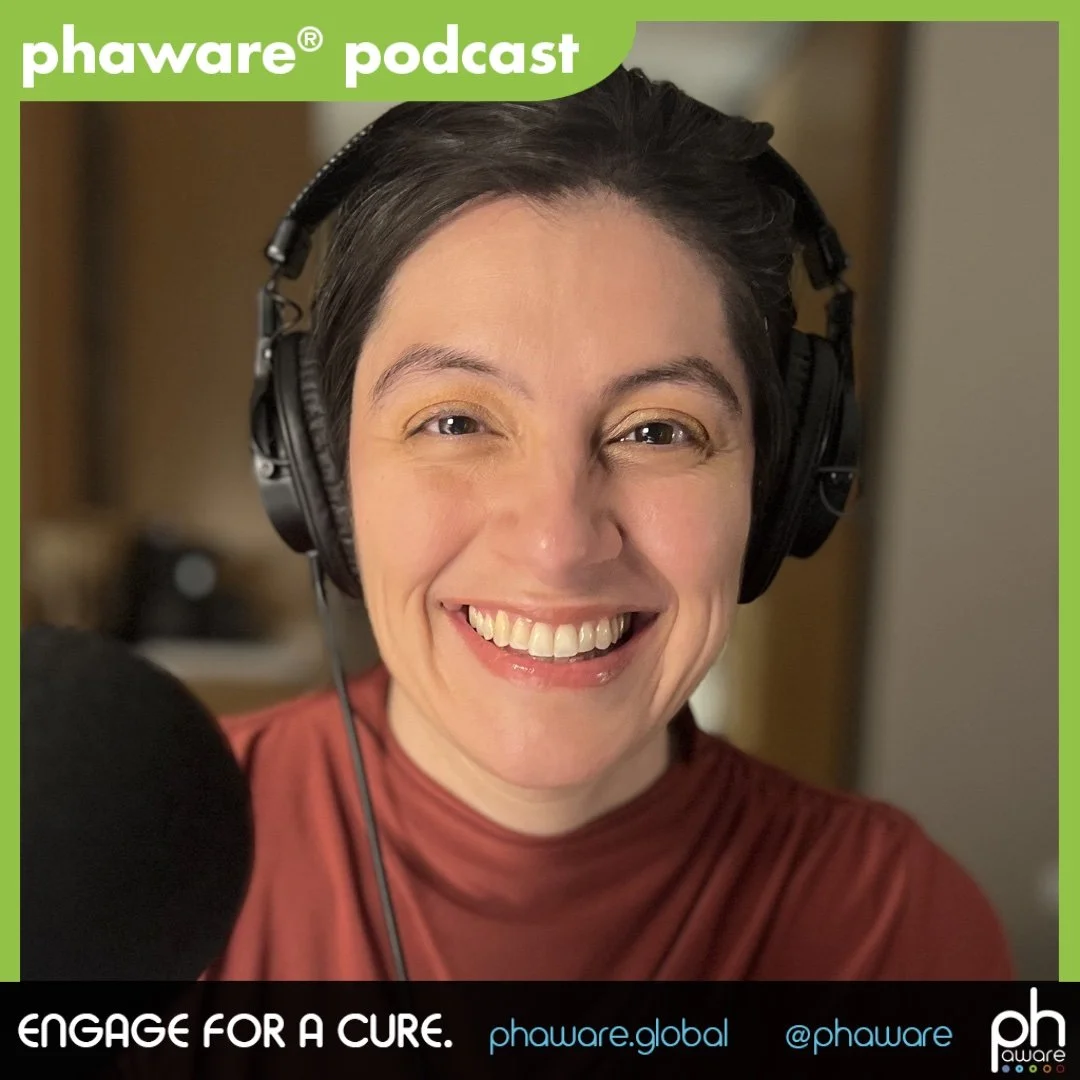
I’m Dr. Naomi Habib. I am a pulmonary hypertension specialist, originally a pulmonologist, and I work in Downtown Phoenix, Arizona. There are so many different Downtown centers. The one that I worked at and that I’ve transitioned to recently is called Norton Thoracic Institute at Downtown at St. Joseph’s Hospital Medical Center. It was really an attempt to really try to get more treatment in the middle of Phoenix where we have a lot of patients who have meth associated PH and all of those difficult to treat PH who come from the middle of the city and really don’t want to have to go out far, but also have availability for those patients as they get worse to then have access to lung transplant, if possible. I was brought on to kind of help with that program that was already being started and so I found it a really awesome opportunity.
I had been doing critical care for a couple of years and realized I was coming to the point where I needed to make the decision between ICU versus pulmonary hypertension. Of course, I love patient care and taking care of patients one-on-one so the choice was very, very easy for me. I’ve been in the medical field for a long time, so I started off as an ICU nurse many, many years ago and realized that I really loved hemodynamics. I loved giving a drug and then watching it work real time and seeing what happened to the hemodynamic waveforms. But what I also realized was that I love to study, more than any nurse should have to love to study. I love to study. So I decided that I really needed to go back to school and eventually made the decision that I wanted to go to medical school.
Before I did that though, I had many important experiences, I think, that kind of changed my outlook on how I take care of my patients and how I educate them about pulmonary hypertension. So that has kind of been something that’s been very important to me as I take care of my patients is how I educate them about their disease and empower them to be able to take care of them, especially in those first months where they’re diagnosed. I think that may not be done as well as it could be in the physician world, just because many physicians don’t see that other side that I got to see as a nurse.
I remember there was probably one of the best examples was I was taking care of a patient in the ICU and the doctor came in and he told the patient, “All right, this is what you have. This is your diagnosis and this is why we think you have your diagnosis on the imaging and this is the next step that we’re going to do for your diagnosis. And if it turns out this way, we’re going to do this. And if it turns out this way, we’re going to do this.” It seemed very, very simple to me and he then asked the patient, “Do you have any questions?” The patient looked at him and he said no. Then, the doctor left the room and the patient looks at me and he says, “What did the doctor just say?”
I was shocked because I understood everything that the doctor said, but the patient had no idea. More importantly, when he was asked if he had any questions, he had no questions. I think what a lot of physicians don’t understand when they try to explain everything as well as they can in the time that they have and then ask the patient, “Do you have any questions?” as sort of a confirmation of understanding, when the patient doesn’t have any questions, it doesn’t mean that they understand what’s going on. It’s very important.
So as I’ve done this more, I’ve started to realize that there’s an almost physical space that happens between the doctor and the patient where there’s a misunderstanding of what’s going on and it’s up to either both of them or one of them to cross that space to get to the understanding that they need to get to so that you can partner with the patient to do what they need to do. That can either be the doctor crosses that space and spends the time drawing the pictures and explaining everything and then asking often on several visits how things are going or it could be him saying, “Here’s the information, go look it up and then come and ask me questions.” Sometimes, the patient has their own wherewithal or they will go and do it on their own. They’re motivated to do that. But a lot of times they don’t even know where to look.
So at the very least what I do is I make sure that the patients know where to look and then I follow up with questions the next couple of visits to assess their understanding of what’s going on. But you have to be very cognizant of there is always that space of misunderstanding that patients have and you’re constantly working on that. Sometimes, as time goes by, it creeps in some forgetfulness too. So there’s always room for reeducating patients on fluid restrictions and salts and that sort of thing because they forget. Re-educating them on, “Oh, do you remember what it felt like to have pulmonary hypertension and be very bad? Remember that time as we talk about your next step in therapy.”
Addressing that elephant in the room and realizing there is that space of misunderstanding and constantly trying to attack that as a physician I think needs to be done a little bit more. And that’s sort of one of the big mottos that I have in my care when I take care of patients is I always try to make sure that they understand what’s going on because they can’t make decisions. They don’t know what’s going on. They’re not motivated to pursue their own care if they don’t understand what’s going on. That’s for any patient, that’s for a meth patient, that’s for a Group 1, that’s for any patient.
A lot of the companies have great education handouts that I can give to them. There’s some online resources. Jeremy Feldman has a wonderful one, www.pulmonaryhypertensionrn.com. I specifically write it out for some of them so that they can go and look on that. What I tell them definitely not to do, don’t just Google it, you have to go on reputable websites to look at what’s going on. But don’t just leave them to their own resources, give them the resources and direct them in the way that they need to go.
If you think about the role of the nurse versus the role of the doctor, the role of the nurse is literally to monitor how the patient is feeling. So they want to know how a patient feels. In nursing school, you’re trained to know how a patient feels. You’re not trained to know what to do with it, but you’re trained to interpret how the patient is feeling and then report that. So nurses are very in tune with being able to pick up on some of those cues. Then on top of that, a lot of them have been bedside first, so there is a very different view you get of a patient when you’re with them 12 hours a day versus you’re in and out in their room in 10 minutes.
That’s why some of the best physicians I know, the first thing they do is go to the nurse and they ask the nurse, “How is the patient doing?” I know how the patient’s going to tell me they’re doing, but how has the patient been doing throughout the day because the nurses are your eyes and ears to how the patient is feeling. Whereas the physicians, when I transitioned, I realized we are much more cerebral. We have to think in terms of diagnoses. We have to think in terms of not only diagnoses, but the probability of diagnoses and sub-diagnoses and treatments and risks and complications and that sort of thing. So incorporating how the patient is feeling is one thing we just sometimes don’t have time for. The bandwidth can be very, very difficult to include, especially when you haven’t been trained to be there at the bedside all day. Quite frankly, that’s not your job all the time.
I didn’t realize that it was an important factor. Even when I went into medicine, I did not realize it. It was only as I started doing it that patients started telling me, “Wow, you treat me differently than most doctors do. You sit and listen to my problems, not just the one I’m here for, but all the problems.” I see people very holistically as most nurses do. You have feelings, you have issues that are not physical that are preventing you from doing the physical things that I need you to do. So I sit here and talk to them about all of those things and listen to them about their aunt or their dog dying or all of those important things that are preventing them from taking their pills today, because they feel so sad.
I’ve always seen them that way and then patients more and more started coming to me and telling me, “Yeah, I’ve never had a doctor that does this.” Then, I realized, oh, I guess my philosophy is a little bit different. That was even after I went into pulmonary hypertension. I realized I loved pulmonary hypertension because I get to invest in all of the lives of patients. There are many primary care doctors and other subspecialists who are terrified of taking care of these patients. So often you become the primary care doctor, the GI doctor, all of the doctors for this patient. I love that idea that I get to do everything for them because I already am anyway.
I think people are starting to pick up on the need to do it. I think as I talk more about it, people are realizing that it is very important. But I think the first thing I’m doing is stepping into the patient’s space. I’m still quite new at this, but I think eventually it may become something that I do more research on and figure out how can we as physicians just sort of connect to our patients a little bit better because often it translates into better outcomes.
I always try to encourage patients to advocate for themselves and empower themselves because that’s the way that they can get the best outcomes. I always ask them to bring their notebooks full of their questions. I have one patient that literally types out every single question that they have and how they’ve been doing. I encourage them to do that. I encourage them to look up things on their own from reputable resources so that they then can come back to me with information and more questions. Those are the biggest things is just coming to me with the education. It’s also very much us as doctors, important to read the patient too. Are they the patient that’s going to go out and find the information on their own? So then I give them the resources. Or are they independent and they actually want to find that information? Or do they have no idea what’s even going on? It’s my job to really sit down and go through in the very simplest of details what’s happening.
There’s the patient that really wants everything and they’ve already looked up everything and they’ve gone and talked to the experts on this topic and they have questions and they already want to get this testing for it. Then, there’s the patient who has no idea and those tend to be patients who have lower socioeconomic status. So those patients I really target with, “So what is your life like? What drives you in your life?”
Fortunately, for most of us, it’s very common. We all have common threads of, “I have kids that motivate me. I have a family that’s very supportive,” or, “I have things that I live for.” It’s finding that bridge of what do you live for and crossing that gap for that patient often gets them to smile and gets them to say, “Oh yes, this is what’s important to me and my doctor knows that that’s what’s important to me too. And if I were gone tomorrow, I would really be sad about X, Y, Z. And my doctor really wants to keep me around for this.”
A lot of the conversations are driven by the clinical trials I have available to me, but I do encourage all of the patients. In fact, the patients that are more passive, the more they get involved in the clinical trials often, the more they feel like they’re being cared for because now not only do they have a doctor and a PH clinical team, they have an entire research team that they can call if they have an issue, they have medications that are delivered to them often at no cost. So it’s actually a benefit. I do try to tell them about all those benefits and educate them on how many things they’re getting when they’re getting into a clinical trial and how exciting of an opportunity it is for them, if it’s what’s best for them. I want to make sure that what I’m offering is what’s good for them.
I think the most important thing is if you can spend just three to five more minutes asking a patient how they’re doing and not talking about their disease, but just asking and identifying that one thing about each patient that you talk about their dog or their family member that’s very important to them, a grandchild or something like that and always trying to make sure they know that you remember that important thing to them. It just opens up a world of conversations and possibility for them.
I’m Dr. Naomi Habib and I am aware that my patients are rare.
###
HELP MAKE PH HISTORY
Learn More phaware.global
Listen & Subscribe phaware.global/podcast
Support the Movement phaware.global/donate
Share Your Story info@phaware.global
Get Our App phaware.global/heartworksapp
Follow @phaware · #phaware