I’m Aware That I’m Rare: the phaware® podcast
Episode 597 - Jenn Turner, MBA, BSN, RN, and Diana Gritsenko, PharmD, BCCCP
Imagine struggling to catch your breath just walking to the bathroom, getting groceries, or cheering on your child. Now imagine living that way every day. Two healthcare professionals took their fight for pulmonary hypertension awareness to the summit of a 14,000-foot mountain and came away with a deeper understanding of what their patients endure. Their Hiking for Hope journey reveals the exhausting reality behind everyday activities, the power of empathy, and why PH can no longer remain invisible.
This Special Edition episode is sponsored by Liquidia.
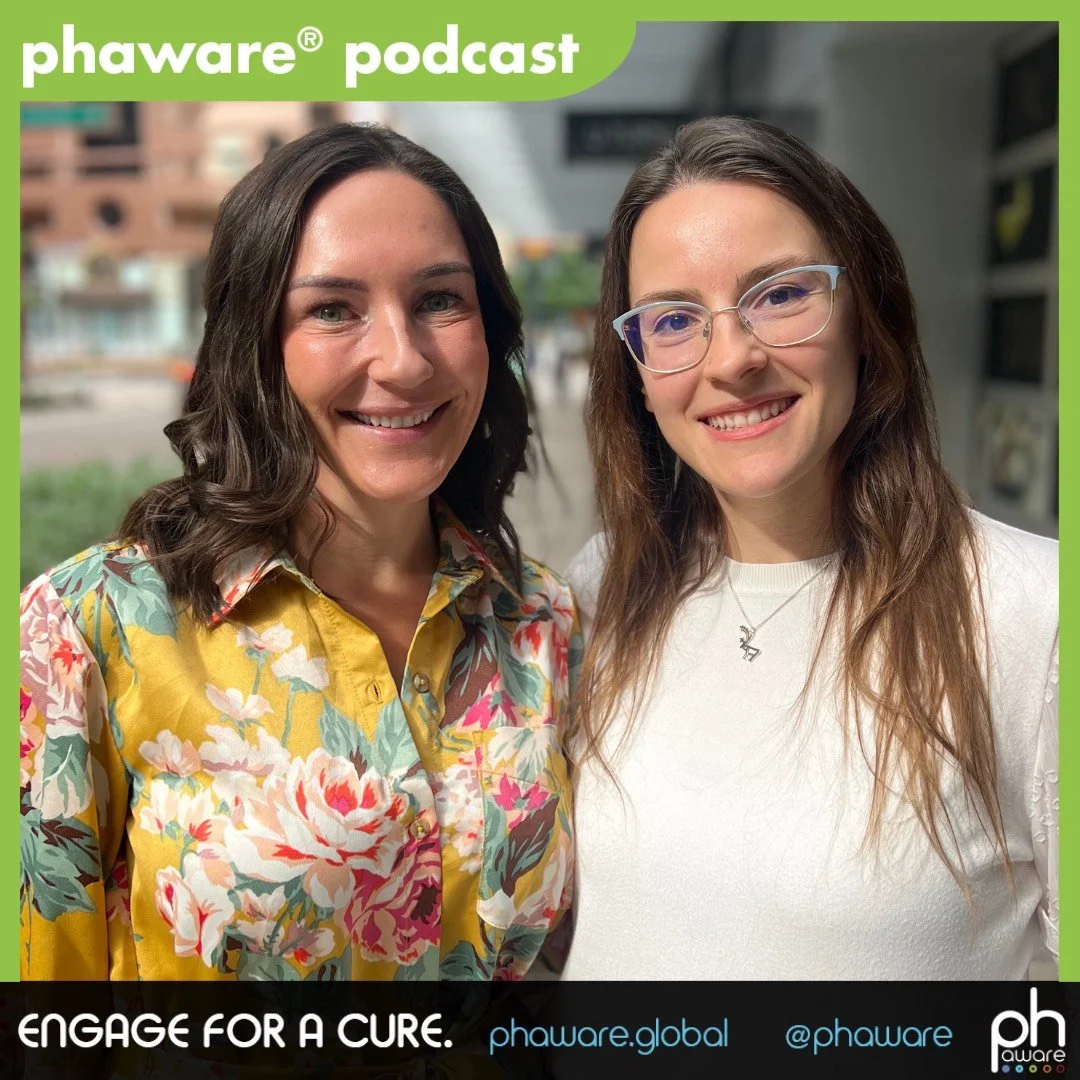
Jenn Turner, MBA, BSN, RN:
My name is Jenn Turner. I'm an MSL at Liquidia. I currently reside in Denver, Colorado. I got into the pulmonary hypertension space about eight years ago. My brother actually has a rare disease, not pulmonary hypertension. When I saw a job come up for the pulmonary hypertension space and I saw that it was in rare disease, that kind of invoked something in me to get involved, because I have a brother who struggles with access to medications, to finding answers to questions that he has about his own disease. That's what really sparked my interest in getting into rare disease.
I've been in the pulmonary hypertension space now for about 10 years. I'm a nurse by trade, and I started actually in patient education. I would go into patients' homes and teach them about their devices, their pumps, oftentimes the scariest point of their life, to be honest. To be able to go into their homes to where they live and have access to them and their families, that was really special.
I felt like that was something that kind of revived my love of nursing. Getting into this space and being there for someone at the scariest point of their life, that's really what kept me here, honestly. So, there's no other space for me now. I have to stay in pulmonary hypertension forever because this is what I love and I love doing this. It started with the patients. It's always been about the patients and that's kind of what drove me to organize Hiking for Hope with Diana.
Diana Gritsenko, PharmD, BCCCP:
Hi, I'm Diana Gritsenko. I'm an MSL for Liquidia. I'm a New York City transplant now living in Connecticut. How I got into pulmonary hypertension is a little bit less noble than Jenn's story. I was voluntold into pulmonary hypertension. When I applied for a medical ICU position at a hospital that I used to work at, it kind of came bundled with pulmonary hypertension. Even among healthcare professionals, pulmonary hypertension can sometimes be a hot potato topic where you try to pass it on to someone else because people are very scared of it with the prostacyclins, what happens if you just abruptly interrupt the therapy and patients can potentially decompensate.
Because it's such a rare disease, even among healthcare providers, it's not something that is commonly known, commonly educated about. It was kind of a role that I fell into, knew absolutely nothing about when I first inherited it, but then as I started going into the data and looking at who my patients were that were showing up in the medical ICU, meeting my pulmonary hypertension team at my institution, it's something that I slowly got more and more involved in. I kind of fell in love with the disease state and just how absolutely important it was for patients.
Also, for providers to just be able to know what it is and what to do when you finally get one of those patients that it's midnight, you have a skeleton crew in the hospital setting. So what do you do when this patient comes in with these complex medical needs and complex pump or device needs? So something that I kind of fell into, but then really learned to love and became my passion, just like Jenn.
Hiking is something that ever since moving from New York City to Connecticut is something that I started to really, really love because I finally got access to the outdoors. Every time when I would climb outside, I would always be the slowest person in my climbing group, the most out of breath, out of shape feeling person. Then, just one day it kind of clicked to like, "Oh, this is how some of my patients feel, but all the time. And maybe just not climbing up a mountain, but walking to the bathroom or getting out of bed and trying to get a glass of water from their kitchen."
When Jenn and I talked about it, that kind of experience that we would get from hiking is something that these patients feel being able to do routine activities of daily living. So it’s something that we wanted to inspire others to get out there and see how their patients feel on a day-to-day basis. I think hiking, especially higher altitude hiking where there's less oxygen available is a really good simulation of that.
Jenn Turner, MBA, BSN, RN:
Diana and I, we started actually the exact same day at Liquidia. We added some time together really intimately when we first started. Just getting to know your colleagues, you ask a lot of questions, we find out what we like and what we don't like. We started talking and I mentioned how I lived in Colorado and she started to mention how much she loves hiking in the outdoors. I'm like, "That's literally why I moved to Colorado, to be outdoors and have access to mountains and the space and the air."
But I will say, even for me, I'm a Denver transplant and the altitude is wicked. When you move or if you go to Colorado, you instantly feel that shortness of breath and it's constant. You're on flat ground and you're just walking at your normal speed, but you start to feel that kind of chest tightness and that shortness of breath.
So when I met Diana and she's this avid hiker, and I love to hike too, maybe not as seriously or strenuously as Diana, but I love hiking and we instantly bonded over this shared experience. Of course, we both love pulmonary hypertension. What's the best way to raise money for such a great cause and for a population that we love so dearly than to make ourselves strenuous, to get out there, to become short of breath, really feel what it's like to have this disease and also raise awareness about it.
We kind of connected those two things. When Seth Hall became the Director of Advocacy, we talked to him about potentially starting a campaign to do Hiking for Hope, where we would raise money by hiking all throughout the year and raising money for patients. He loved the idea. So that's kind of how it was born.
Then, Diana and I decided we're going to do this really intense three-day peak pinnacle of our hiking experience. We set up some time in August where Diana came out to Colorado and we did three days of just back-to-back hiking, raising money and really physically exerting ourselves over those three days. But it was a lot of fun and we had a great time just raising awareness.
Diana Gritsenko, PharmD, BCCCP:
For me, at least the most memorable part of making it to the top of Mount Bierstadt, it was like a bluebird day. It was absolutely gorgeous weather. Naturally, there were so many people up at the summit there with us, lots of people taking pictures. We had a gigantic Team Phenomenal Hope flag that we essentially unrolled and we were taking photos with it. So many people that were there were looking at the Team Phenomenal Hope flag and they're like, "Oh, what is this? What is Team Phenomenal Hope? What are you guys fundraising money for?"
Jenn absolutely killed it with explaining to them what Team Phenomenal Hope is, getting people excited about it, and just what pulmonary hypertension is and how it feels like when you're at ground level and oxygen is great. People understand, but it's a different level of understanding when they're also up there with you. They're also short of breath and you're explaining to them that how short of breath you are right here at the top of this mountain, that is how a lot of patients are, if not worse. They may potentially be on oxygen around the clock. They have very limited mobility. So, while we are essentially chasing this feeling of being short of breath at the top of the mountain, this is a daily reality.
For a lot of people, when we kind of brought it up like that in that context, it really did click with them what pulmonary hypertension is. So many people got so excited. We had so many people telling us that like, "Oh my God, we're going to donate once we get off this mountain and we get cell phone service." Yeah.
Jenn Turner, MBA, BSN, RN:
I think for me, my background in nursing, I've worked in cardiovascular ICUs throughout my career and then came over to pulmonary hypertension. I was experiencing firsthand with patients in crisis, in the hospital when they were admitted, in their homes doing follow-up, teaching and care. You do experience that and you see it, but it is quite different. You're getting a snapshot. You may spend four hours with the patient talking to them and teaching them about their devices, but you're not actually getting a full what is reality for this patient.
I will say, when we went to Mount Bierstadt and we were hiking up to 14,000 feet, I was having to stop. I was so short of breath. I was looking at my heart rate, making sure it was going to come back down before I started walking again just to ensure my own safety. I'm a very physically active, healthy person.
I think in that moment, that really kind of clicked for me. I'm just walking essentially a gigantic hill, but I am having to stop, take a deep breath, allow my heart rate to come back down to normal so that I can proceed with this activity. For me, it was like a light bulb. This is literally what patients are doing, except it's to the bathroom, it's to the grocery store, it's to their kids' baseball game, it's their everyday life. It's honestly a pleasure to feel that because truly that's more profound for me to feel and understand than, "Yes, I know you're short of breath." I physically can feel it with you.
Diana Gritsenko, PharmD, BCCCP:
I think I had a similar experience to Jenn, as well. I'm a critical care pharmacist by training and during residency we had respiratory therapists come over and kind of give us some information about the mechanical vent and what it looks like. Then, they gave us a piece of ventilator tubing so that we can breathe through it and see what it feels like for our patients who are mechanically ventilated.
That experience, when I was a resident really stood out to me, because you can read about it, you can hear about it, but until you actually feel it, it's completely different experience. So, similar to what Jenn was saying, when we were up on that mountain, it was a completely different experience of I'm just walking. I'm not walking particularly fast up this hill and I'm short of breath, nauseous, headaches are coming on because some of us also came down with altitude sickness when we got there. It's not just being the short of breath. There's also things that kind of come as a result of you having to push yourself through those stages of fatigue and the shortness of breath.
If a patient who is short of breath and on oxygen who has pulmonary hypertension wants to kind of go out to see their kids' graduation ceremony, they have to really push through the pain of what they're feeling, the shortness of breath of what they're feeling, take multiple breaks, stop. They have to have an entire support network behind them to be able to accomplish this task, which I think all of us to some degree probably take for granted.
Kind of going through this whole training process of just training for several months before our climb, getting support from our partners to be able to do the training for this, then the logistical support of getting up to that mountain, driving there, figuring out the works of how to physically get up this mountain and even support on the mountain kind of really highlighted it for me that this was a team effort.
Yes, it was definitely me and Jenn who were coming up this mountain, but there was so much background love and support that we had from our company, that we had from our partners, from our friends. It just kind of goes to show you that it's a team effort even for something like this. It's also a team effort for a lot of our patients to be able to do things that they want to do, like go to a graduation or go to their kid's wedding.
Jenn Turner, MBA, BSN, RN:
It does take a community. This is a rare disease. A lot of people don't know about it, so you have to find strength and you have to find positivity and hope through those people around you. You really have to rely on those people to build you up, to take care of you, to push you on good days, on bad days, to motivate you. For me, I think that highlights as well, just this is such a small but mighty community. When you're ready to stand up and advocate and support this community, people will rally behind you because we know how important it is.
There was a lot of preparation that went into our three days of hiking. We did one day of hiking in Garden of the Gods. We did a day where we essentially climbed 3,000 stairs that are very vertical, like a 45 to 60% grade. Then, we did our last day, which was kind of our peak event, was getting to the summit of Mount Bierstadt, which is over 14,000 feet. In preparation for that, it was a lot. We spent months on the stair climber, getting ourselves prepared for just the endurance of the activity of running, walking, training our legs to make sure they could actually carry us up.
Because we're going to higher altitude, the start of our summit to the peak of Mount Bierstadt was around 9,000 and then getting to 14,000 feet, there is the component of altitude. So I was looking into online pharmacies to get altitude sickness medication to have that shipped to me prior to going up there because I wanted to do everything I could to ensure that we were going to be safe and that we would be successful.
For someone who is not normally short of breath, doesn't have all these things that they have to deal with with medications, that was a very small amount of preparation over the course of months where patients are dealing with this every day. They're calling pharmacies. They're waiting on hold. They are literally doing this just to live. If they want to go out of the house, they have to pack up their oxygen tank. They have to have their medications just in case something happens. They need their rescue medications in case they have some sort of crisis or exacerbation while they're out of the house.
For me, getting on an online pharmacy and clicking a few buttons so that I can get some altitude sickness medication pales in comparison to what our patients are going through. Even for me, I was like, "This is not great. I don't love doing this part of it, but I have to ensure I'm safe when I get up there."
I think in retrospect, looking back, it's a very small amount of what we had to do to continue hiking and to be safe, but totally worth it. It really does put into perspective how hard these patients work and how much they have to push through to just carry on. They're so motivating. That's kind of what brought us here. That's what brought us to Hiking for Hope was we can push ourselves outside of our comfort zones because patients push themselves every single day.
Diana Gritsenko, PharmD, BCCCP:
Then, some of the stuff that we had to carry up the mountain to make sure that we were safe, we think about the patient who might have to carry their medication supplies with them, their pump with them, might have to carry oxygen or a compressor with them, any other background or rescue therapy meds that they might need. They carry a lot of different items just to be able to do daily things that they need to get done.
But then when we think about what we did for hiking, we had to carry a bunch of stuff up the mountain, too. We had to carry extra layers in case the weather turned. We had to carry all of our food and water on us, because there was no way to get more food and water up there. But we had a very nice ergonomic, specially built 30 to 60 liter backpack that made it very easy to kind of lug all of that stuff around. Multiple pockets, everything was super well accessible. Even though we also had to prepare well in advance and make sure we had everything on us that we would need, for us, it felt easier than potentially having to lug around an entire canister of oxygen around when you're already short of breath.
I've had a few patients who would report to me that, yes, they're on oxygen. They can hook themselves up to an oxygen tank if they need to go and get their mail or if they need to go to the grocery store. But some of my patients will fail. So are they able to lug that oxygen canister around certain obstacles or certain little steps that they need to get out of their house or go to the grocery store? It was very difficult to maneuver. So even for us having to carry all this stuff, it was easier for us to maneuver it because everything was just nice and cinched up on our backs.
Jenn Turner, MBA, BSN, RN:
I want people to recognize that there is this rare disease that we need more advocacy for our patients. We need funding for research. We need people to speak out and speak up for this population, because we can take that on. These patients, like we said, are every day battling with insurances, with oxygen companies, with home health, and they're going through so much just to live their daily lives.
We can take this. We can take advocacy. We can take awareness. We can take that and spread it into the community so people are educated. They know there's this rare disease. I think when Diana was saying we get to the top of the mountain and we're unfurling our big Hiking for Hope sign and people are like, "I know there's lungs on that. What are you hiking for?" We started talking about Hiking for Hope and pulmonary hypertension and kind of our clinical backgrounds of how we got into pulmonary hypertension. People were ecstatic to learn about it. They had no clue. They wanted to know more. For us, it was like, "Please donate to this amazing cause so that we can keep doing this, so we can get out there and spread awareness." It was kind of a highlight of the whole hiking experience for me was being up there.
I'm kind of an educator by background, so I've done a lot of training in all of my previous roles. In nursing, I think you're kind of always educating patients, but it was so fun to be on the top of the mountain just educating people like, "This is why we're here. What you feel right now is what our patients live with on a daily basis." Everyone was just in awe that patients exist in this fashion, that they have to go through this on a daily basis and that there's no cure for them.
When we were talking about that and we were saying this is a progressive disease where patients start with shortness of breath, but it does evolve and there's no cure, I think it got everyone that was on top of the mountain kind of excited to donate to raise awareness and to be a part of our campaign.
Diana Gritsenko, PharmD, BCCCP:
I think raising awareness of just the disease state to anyone and everyone who would listen would be an excellent thing to kind of get out of this because I had so many patients that would present. They started with shortness of breath, they're not able to walk as much as they used to be able to walk. For some, that shortness of breath came on quick. For others, it was very slow and insidious. Then, people kind of don't think anything of it. Shortness of breath is a very common symptom that shows up with, name any respiratory or cardiovascular kind of disease state, it's usually a symptom of it. It could be a nothing symptom, it could be an everything symptom.
Just having people aware of what pulmonary hypertension is, what are the symptoms of it, how it kind of looks like, what your patients might look like through all the different kinds of stages, I think, would be important so that patients can advocate for themselves if they start developing symptoms, kind of go out and try to solicit for providers to evaluate them and see if there's something going on. Also, for providers to be aware of what pulmonary hypertension is and all the different logistical challenges that kind of come with it, the diagnostic challenges that come with it, I think would be key.
Jenn Turner, MBA, BSN, RN:
For people that want to dive in, find out more, I think it's education. Really just starting simple at the basics of learning what pulmonary hypertension is and how it affects patients. Diane and I, we did this extreme three-day hike where we're climbing literal mountains. It doesn't have to be that extreme. Whatever it is that you like or you're passionate about, you can take that and use that to raise awareness.
We had some team members that wanted to help fundraise and they're like, "We're not runners. We're not hikers." That's okay. For people wanting to get into this, just raising awareness and talking to people because if we had not summited that mountain, we wouldn't have met those 10 to 15 people or potentially up to 30 people that we saw on the trails. Zero of them knew about pulmonary hypertension, zero. There was a retired doctor at the top of the summit that we met. She had never heard of pulmonary hypertension.
Just talking about it. If you are into the pulmonary hypertension space and you care for this community, speak up. You have to speak up, because not everyone knows about it. If we are actively speaking up and talking to people and raising awareness, our one voice that day on the mountain informed 30 more people about pulmonary hypertension. If each of those people taught one more person, right? It's kind of a ripple effect. If you talk about it and you teach people and they understand, I think they will also talk about it and teach people and help people understand. That's how we can get the message out, just that ripple effect of I tell one person and they tell one person and that person tells one person. Now, all of a sudden we have more awareness in the community.
Diana Gritsenko, PharmD, BCCCP:
It doesn't just have to be hiking, which is what we just chose on just because of the altitude feeling kind of simulating that shortness of breath feeling. But I've had a patient who realized that something was wrong. She was a triathlete, competed multiple times, and then noticed all of a sudden that her time was kind of slowing down on most of her runs and most of her bike rides. When you compare what she can run and what she can ride compared to what I can do, it was like she was still worlds ahead of what most people are able to run and bike. But she noticed when she was just slowing down.
I had another patient who was an avid golfer, and he realized that he wasn't able to do the same 18 holes the same way before. Walking between the different holes was causing him a lot of fatigue. Someone else noticed when they were just doing their daily walks around the neighborhood after dinner with their significant other and they realized that they were becoming more fatigued, more short of breath. So, really any activity is a great activity to kind of help raise awareness for pulmonary hypertension. Anything just kind of gets that name out there, as Jenn was saying.
Jenn Turner, MBA, BSN, RN:
I think for me, if a patient is listening to this podcast, is really just to let them know that we are here. We're supporting you. We're behind you. You may not physically know us. You may not have ever met me in your life, but you have people in your corner and we are fighting for you. We're there. We're hiking. We're raising awareness. We are going to continue to educate people who don't know about pulmonary hypertension. We're going to keep putting ourselves out there until more and more people know.
Pulmonary hypertension can be a very daunting disease. There are a lot of days I think that patients struggle with pushing through and finding hope. I just want them to know that we are here for those days that maybe you don't feel like you have hope, but we are here in your corner and we are going to keep fighting.
Diana Gritsenko, PharmD, BCCCP:
I think for any patient that's listening, it's important to know that you are not alone. You have so many people that are in your corner, whether you know them or not. You have all of these people from different drug companies that are working together to try to come up with new therapies. You have healthcare providers from all over the US. You have pharmacists, nurses, RTs, MDs, NPs, PAs, everyone who are learning more about the disease state, learning how to advocate for this disease state. You also have other patients.
I think for some of my patients when they first got diagnosed with the disease, learning about patient support groups was really vital for them. Just being able to talk to someone else who is also going through what you're going through, who went through what you're going through right now. They can help offer you a fresh perspective, fresh insight. I think find support groups that are in your area.
There's also a ton of supports in social media. I've seen a lot of people on Instagram and Facebook that kind of advocate for the disease state and awareness and always offer, if you need someone to talk to, you're diagnosed with pulmonary hypertension, reach out. There's so many resources. I know it may not seem like it at the time, especially with a new diagnosis where you kind of feel very alone. All you have to do is kind of try to reach out and ask, and then there will be essentially a legion of people that are willing to help you.
Jenn Turner, MBA, BSN, RN:
You don't have to go through this alone. There's so many people, and I think with a rare disease that is progressive, patients can feel sometimes like it consumes their whole life and they become this maybe a burden to their support system, to their families, to their friends, and they are talking about their disease a lot.
But you're not. You're not a burden. Everyone has good days, has bad days, and that's why we're here. Reach out. I would be happy to talk to every single patient who is out there with pulmonary hypertension, because I truly care about this community and this disease process. I think that's important to know that you always have someone. There is always someone here that is ready to talk to you. If there's days where you lack hope, you can lean on us. We can provide that hope for you on the days when you don't have it yourself.
Diana Gritsenko, PharmD, BCCCP:
Thank you for listening. I'm Diana Gritsenko.
Jenn Turner, MBA, BSN, RN:
And I'm Jenn Turner, and we're aware that our patients are rare.
###
HELP MAKE PH HISTORY
Learn More phaware.global
Listen & Subscribe phaware.global/podcast
Support the Movement phaware.global/donate
Share Your Story info@phaware.global
Get Our App phaware.global/heartworksapp
Follow @phaware · #phaware